🇯🇵
€105,000
In stock
Year
2023
Mileage
31,000 km
Power
490 hp
Commissioned for its owner. We took the brief, found this Lotus on the open market, vetted it hard and brought it home to Cyprus. The car's placed, the service isn't. Tell us what you're chasing and we'll go get it.
Commissioned


 Memory seatsPremium audioAlloy wheelsCruise controlAndroid AutoStart/stopLeather seatsParking SensorsFolding MirrorsHeated seatsRear view cameraApple Car PlayKeyless start
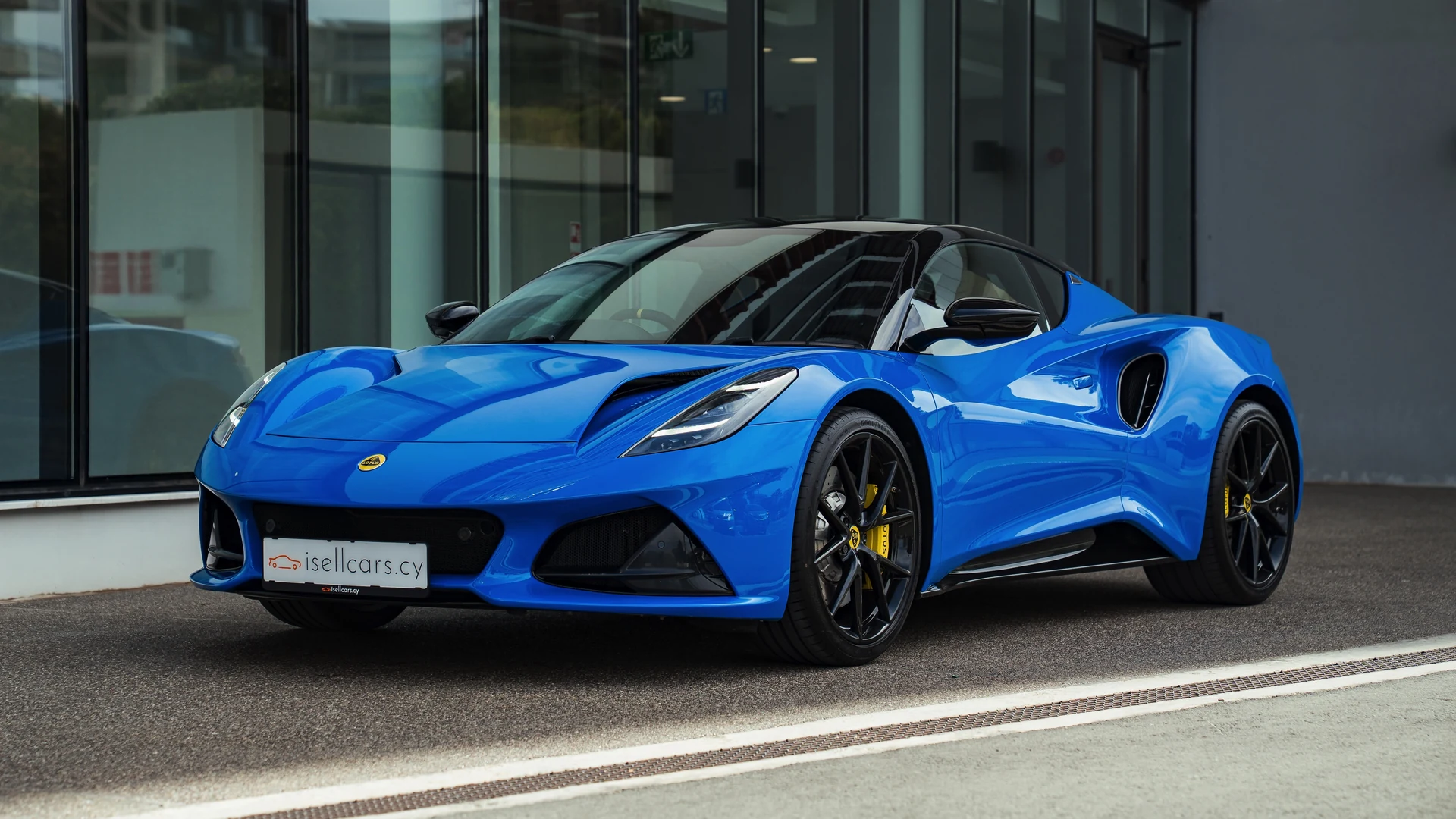
2024 Lotus Emira First Edition in Seneca Blue metallic is the kind of car that stops conversations in Limassol car parks. This is Hethel's definitive mid-engine statement built on the Elemental platform, and it carries a weight that goes beyond engineering: the Emira was launched as the last Lotus to be powered purely by internal combustion. Whether the brand ultimately follows through on that promise or pivots to hybridisation, this First Edition captures the moment when Lotus drew a line under decades of analogue sports car making. This specific Lotus was commissioned through isellcars.cy from Northern Ireland and delivered to its owner in Cyprus with 13,000 km on the clock.
The mechanical heart sits behind the cabin: a 2.0-litre turbocharged four-cylinder sourced directly from AMG, producing 360 hp and 430 Nm of torque. Every newton-metre is routed exclusively to the rear axle through an eight-speed dual-clutch transmission. The result is a 0, 100 km/h sprint in 4.4 seconds and a top-end pull that feels considerably more urgent than those numbers suggest on paper. But straight-line velocity is not what makes an Emira an Emira. What defines this chassis, what separates it from every rival in the segment, is the hydraulic steering rack. Lotus stubbornly refused to fit electric power steering on this car. The reasoning is simple: hydraulic assistance preserves a direct mechanical connection between the front contact patches and the driver's hands. Every surface change on the Troodos tarmac arrives unedited, without the synthetic weighting that plagues most modern sports cars. In an era where steering feel has become a marketing bullet point rather than an engineering reality, Lotus delivered the real thing.
The sourcing logistics on this particular car illustrate how a commission works end to end. The Emira was located at a dealer in Northern Ireland, collected by a transporter and moved to the UK mainland without adding a single kilometre to the odometer. From Southampton it was loaded onto a RoRo vessel for the sea crossing. The voyage to Limassol port took exactly 18 days. Once cleared through Cyprus customs, the final handover took place at the customer's doorstep on the very next working day. No intermediate storage, no waiting around, no loose ends.
Externally the Seneca Blue metallic paintwork takes on a different character entirely when paired with the factory Black Pack. Body-coloured roof panels are replaced with gloss black sections, the lower air intakes are darkened and the rear diffuser houses black chrome exhaust tips that bark a sharp four-cylinder staccato on aggressive downshifts. Unsprung mass is kept in check by gloss black 20-inch forged alloy wheels. Behind those tight spokes sit upgraded brake calipers finished in a vivid yellow that deliberately bridges the exterior palette to what happens inside the cabin.
Swing the dihedral-style door open and the interior proves that Lotus finally cracked the quality problem that haunted every Hethel product before the Emira. The strict two-seat layout is an exercise in focused ergonomics. Black leather covers the primary seating surfaces while high-friction Alcantara sections grip the bolsters, a functional material choice that genuinely holds occupants in place during sustained cornering rather than serving as a trim decoration. Yellow contrast stitching and piping run throughout the cabin, tying every surface back to those brake calipers outside. The memory seats offer full electric adjustment, a luxury that would have been unthinkable in any previous Lotus, alongside heating elements for early-morning blasts through the Troodos mountains when the air still bites.
KEF premium audio system uses aerospace-grade Uni-Q driver technology to fill the cabin cleanly without fighting the mechanical soundtrack. Apple CarPlay and Android Auto are standard. Navigation through tight Limassol backstreets is simplified by a high-resolution rear-view camera working in tandem with parking sensors. Cruise control handles motorway stints. Automatic folding mirrors protect the composite body panels in tight parking bays. Keyless start manages ignition duties. Tinted privacy glass shields the cabin from intense Mediterranean UV exposure.
Despite the mid-engine architecture, everyday usability was clearly a design priority. Boot capacity reaches 359 litres, split between a 151-litre cargo bay accessed behind the engine and 208 litres of deeper storage behind the seats. That is enough for a weekend bag and a set of helmets without any creative packing.
 Lana Luu
 Aleksei Makeev
 Phillip Black
 Filipe
 Kerry Palourti