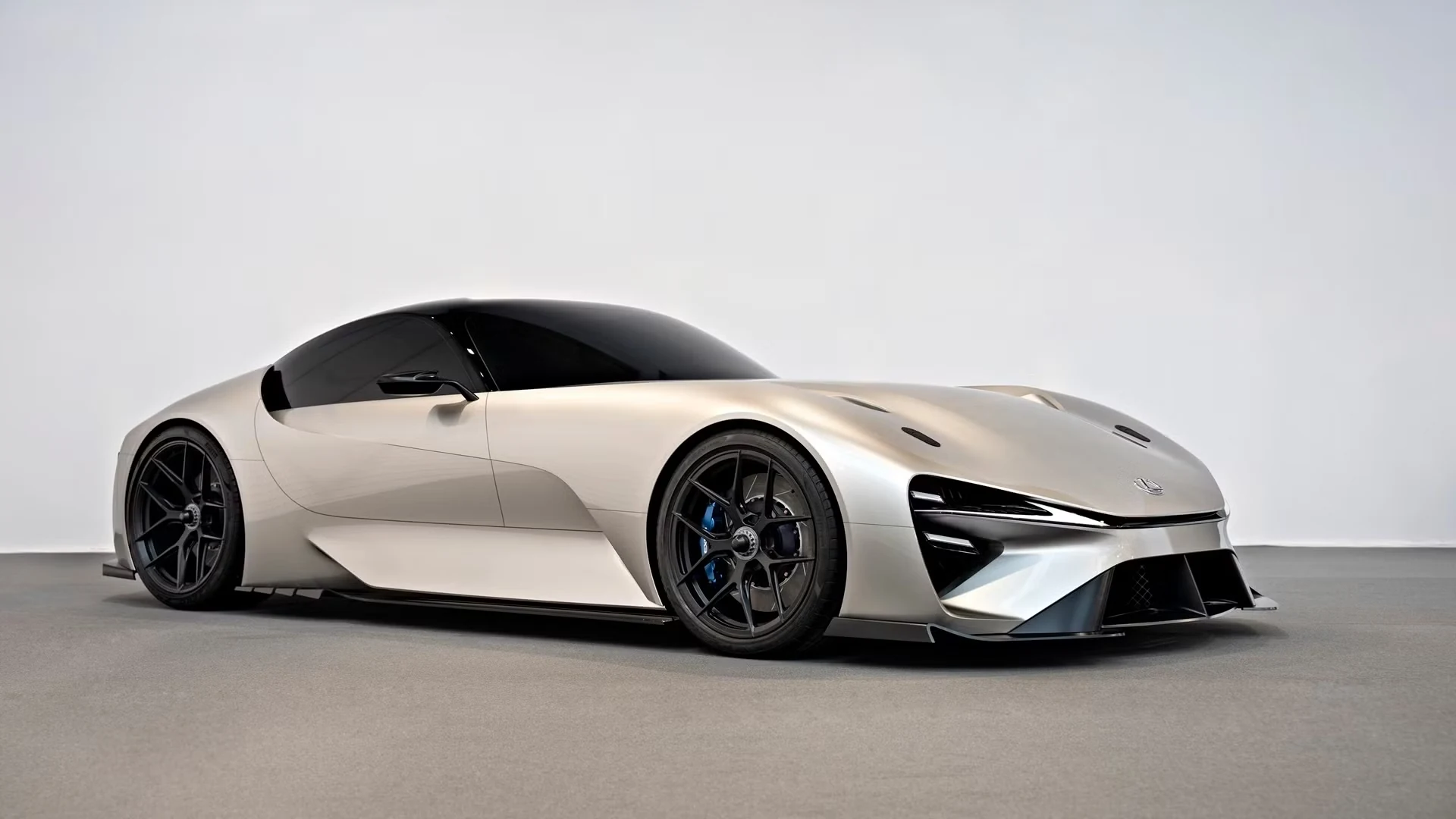
Lexus has renamed its dramatic sports-car study the LFA Concept — and the twist is big: this is not a high-revving V10 throwback but a battery-electric prowler built to explore the cutting edge of EV performance. Seen first in Monterey and later with a full cabin reveal at the Japan Mobility Show, the concept now wears a clearer mission statement: take supercar DNA and retool it for an electrified future. Underneath the flared bodywork the LFA Concept abandons the original LFA’s pricey carbon-fibre tub in favour of an all-aluminium spaceframe. That’s a notable pivot: aluminium structures are tougher to shape for the ultra-lightweight aims of a purist supercar, and the change hints that this iteration will be heavier than its celebrated ancestor.
For context, the V8-powered Toyota variant that shares some architecture already lists a kerb weight around 1,750 kg; adding batteries will raise that number further. Lexus is clearly prioritising structural flexibility and production readiness over obsessive weight-savings. Where this car becomes genuinely exciting is as a test bed for Toyota’s next-generation battery plans. The firm says solid-state cells are closing in on viable mass production, with a realistic window around 2028 — and the LFA Concept appears destined to prove that promise on the road. Solid-state chemistry promises higher energy density, improved performance across a broader temperature range, better safety in the event of a crash and, crucially for drivers, lower mass for a given capacity. In short: more range, firmer packaging and a step closer to combustion-car packaging dynamics in an EV shell. Driving experience is clearly a focus.
Lexus is developing augmented engine sounds and simulated gearshift effects to inject drama back into electric propulsion. Expect carefully tuned audio cues — potentially recreating the cinematic crescendo of a V10 — generated through high-end speaker systems rather than mechanical exhausts and intake noises. Yamaha has a history of helping craft exotic engine tones for previous projects, and now those sculpted soundtracks may come from the cabin’s audio architecture rather than from a physical engine. The cabin showcased at the Mobility Show telegraphed a new Lexus design language. A sweeping dashboard curves toward the driver, separating the cockpit mood from that of the passenger with differing colour treatments and surfaces. At the centre of the interior is a three-surface digital display that both visualises and controls core driving functions, integrating critical telemetry with tactile control and reducing menu dives. It’s a driver-first environment that marries theatrical presentation with usable ergonomics — an approach the brand has already flirted with on the LC Coupe.
There are practical questions remaining. Total mass and precise power figures haven’t been revealed, nor has a confirmed production timeline for a road-going model. Lexus has, however, reiterated its intent to turn the concept’s innovations into production hardware. If solid-state batteries arrive at scale as forecast, a future LFA-inspired supercar could combine the raw ambition of the original with modern electric performance and packaging advantages that today’s lithium-ion tech can’t match.
This concept is less a nostalgic reissue and more a manifesto: the supercar of the next decade will be electric, digitally orchestrated and built around novel energy storage. That means familiar thrills delivered by unfamiliar means — digital symphonies in place of exhaust notes, instantaneous torque balanced by clever chassis tuning, and a striking cabin design that puts the driver at the heart of the experience. The Lexus LFA Concept may not roar in the traditional sense, but it promises to redefine what a high-performance Lexus feels like on the road.