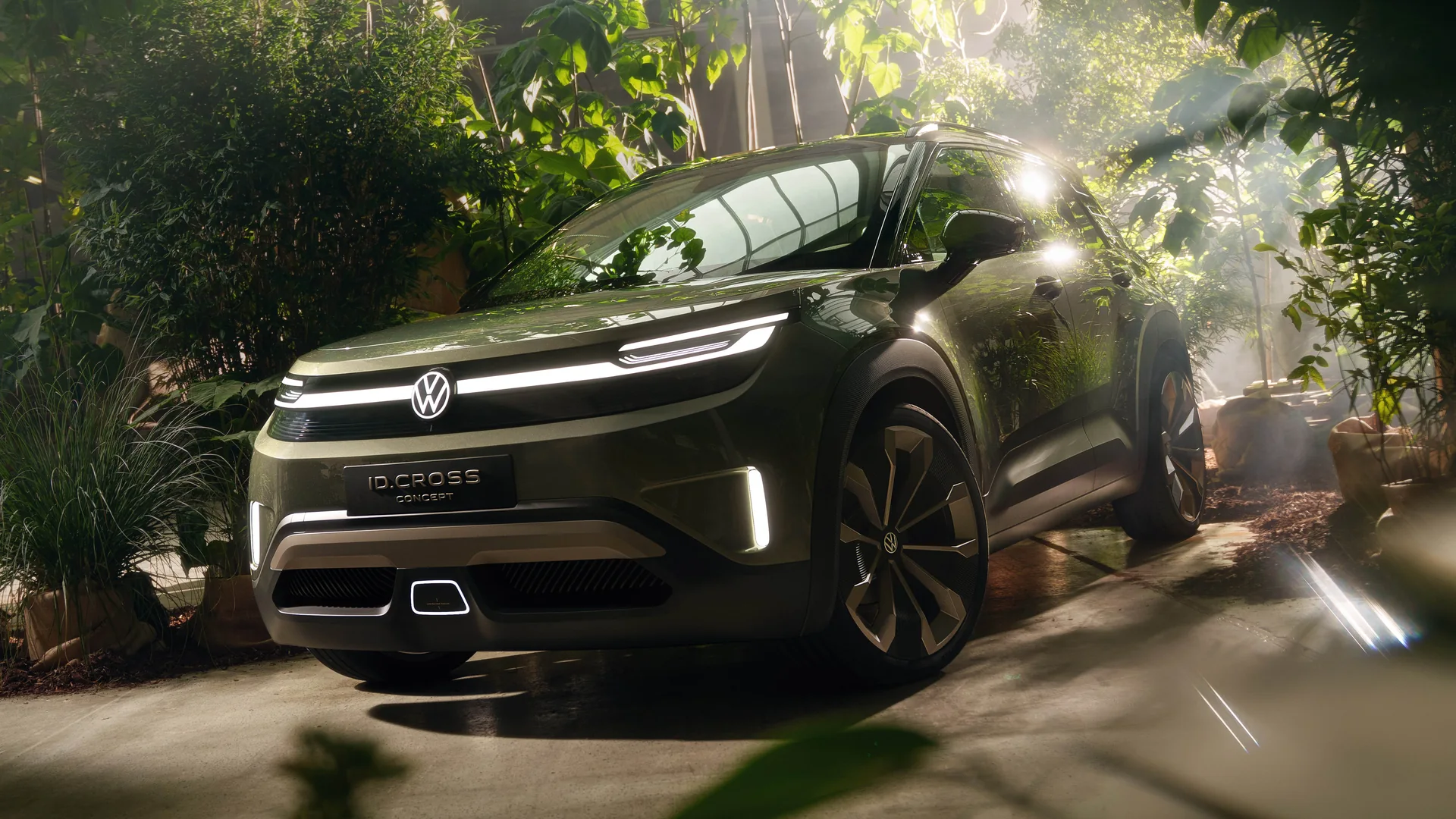
Volkswagen has shown the ID. Cross Concept, its entry into the small electric SUV segment. European launch is planned for late 2026 at approximately €30,000, against the Renault 4 and the coming Kia EV2.
The ID. Cross is the electric counterpart to the T-Cross, in the same way the ID. Polo will sit alongside the petrol Polo.
The naming change matters
Volkswagen is bringing back familiar names. The "ID." prefix stays, but Polo, Golf and possibly GTI return with it — a deliberate move away from numbered models toward badges buyers already recognise.
The sequence: ID. Polo in early 2026, then ID. Polo GTI, then ID. Cross later in the summer. The production version of the ID. EVERY1 concept follows in 2027 at under €21,000.
What that ladder shows is a manufacturer trying to build a full electric range at prices ordinary buyers reach, rather than a halo model and a gap beneath it. If you are not waiting, the existing range already covers part of it — an ID.3 sits just over €30,000 and an ID.4 under €40,000.
The ID. Cross was previously known as the ID.2X, and speculation began with a teaser image in late 2023. Volkswagen says the concept is close to the production car rather than a styling exercise.
Design and packaging
Design chief Andreas Mindt describes the approach as "Pure Positive," built on stability, likability and character. The ID. Cross combines the T-Cross silhouette with cues from the Amarok pick-up: a glass panel at the front housing an illuminated badge and lightbar, slim 3D-effect LED headlights, flared arches and a floating roof in Urban Jungle green against black A- and C-pillars.
Inside, Volkswagen has responded to criticism of its touch controls. A square steering wheel reintroduces physical buttons, and climate controls become toggles. Materials are soft-touch in a beige called Vanilla Chai, with bouclé fabrics — and, less conventionally, eucalyptus leaves set behind translucent trim and a fragrance dispenser in the cup-holders.
At just under 4.2 m long, it seats five with a 450-litre boot and a 25-litre frunk. The MEB+ platform is shared with the ID. Polo, Cupra Raval and Skoda Epiq, all built in Spain.
Volkswagen quotes up to 420 km of range from a 208 hp front-mounted motor.
What this means for a buyer in Cyprus
420 km is more than the island demands. Cyprus is 240 km end to end; Limassol to Nicosia is 85 km. For a car of this size and price, range is not the limiting factor here — home charging is.
Under 4.2 m is the real selling point. The old quarters of Limassol and Nicosia, and the mountain villages, were not built for the size modern SUVs have reached. A compact footprint with SUV height is a better fit for how the island is actually laid out than anything in the segment above.
Physical climate controls are worth more in this climate. Air conditioning runs eight months a year here. Adjusting it through a touchscreen menu while driving is a real irritation, and Volkswagen reversing that decision is a practical gain rather than a styling note.
A 450-litre boot in a 4.2 m car is the practical test. Most compact electric cars lose luggage space to the battery. This one does not, and it adds a 25-litre frunk for cables — which matters more than it sounds, because the alternative is a charging cable living in the boot for the life of the car.
Road tax sits in the lowest band. Fully electric, so the CO₂-based Cyprus calculation puts it at the bottom — worth quantifying against the petrol crossover you might otherwise choose.
For compact electric and hybrid models available on the island now, see our catalogue of cars in Cyprus.