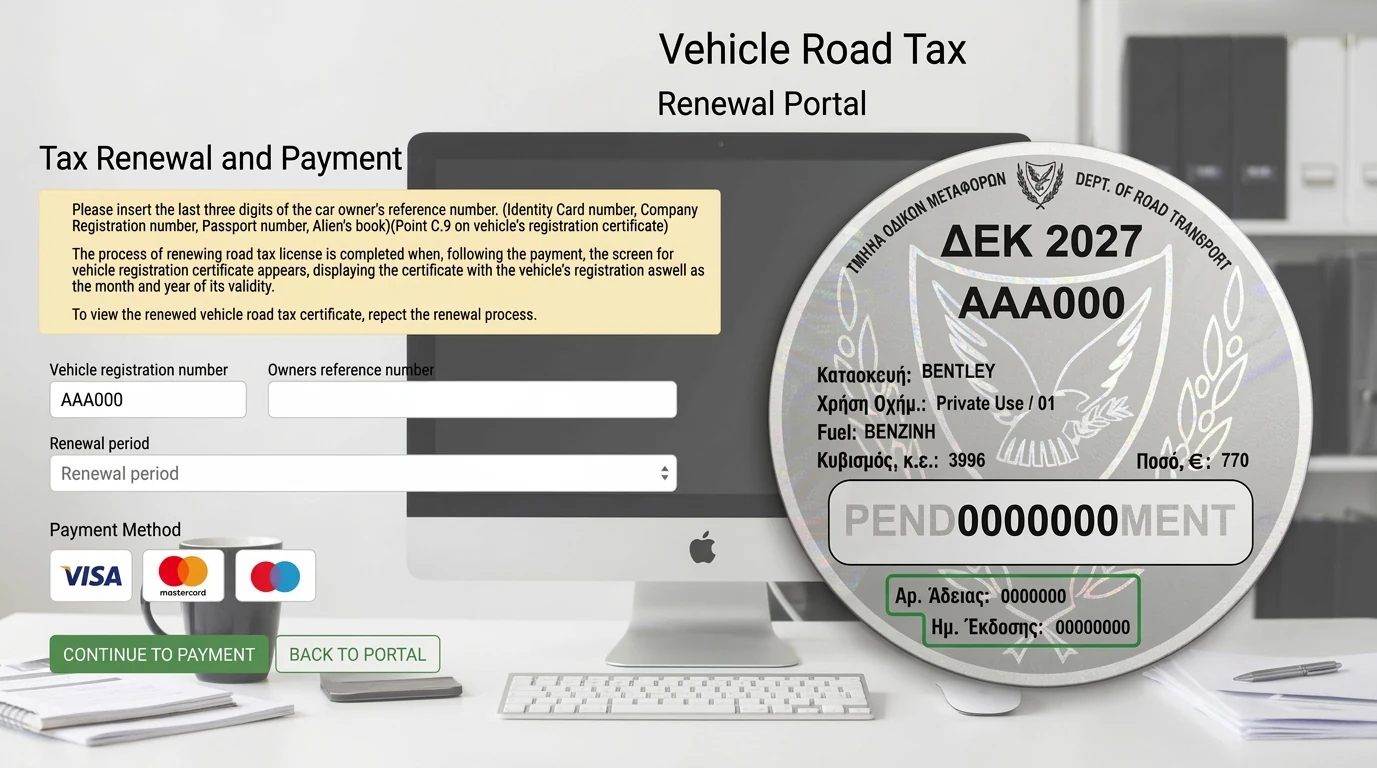
This is about paying and renewing your road tax. It doesn't work out the amount — if you don't know that yet, the road tax calculator gives you a figure in under a minute. Then come back here for where to go and what to click.
For most owners it takes about ten minutes, provided the right documents are to hand. There are three things that catch people out, all small: one field on the form that isn't obvious, insurance details you have to type in by hand, and one screen you mustn't close.
Road tax is renewed once a year. The window opens in January and the deadline falls in March. In 2026 the deadline was moved to 31 March.
What to have ready
Get everything together first — the portal won't let you save a draft and come back.
Your vehicle registration number, as it appears on the plate.
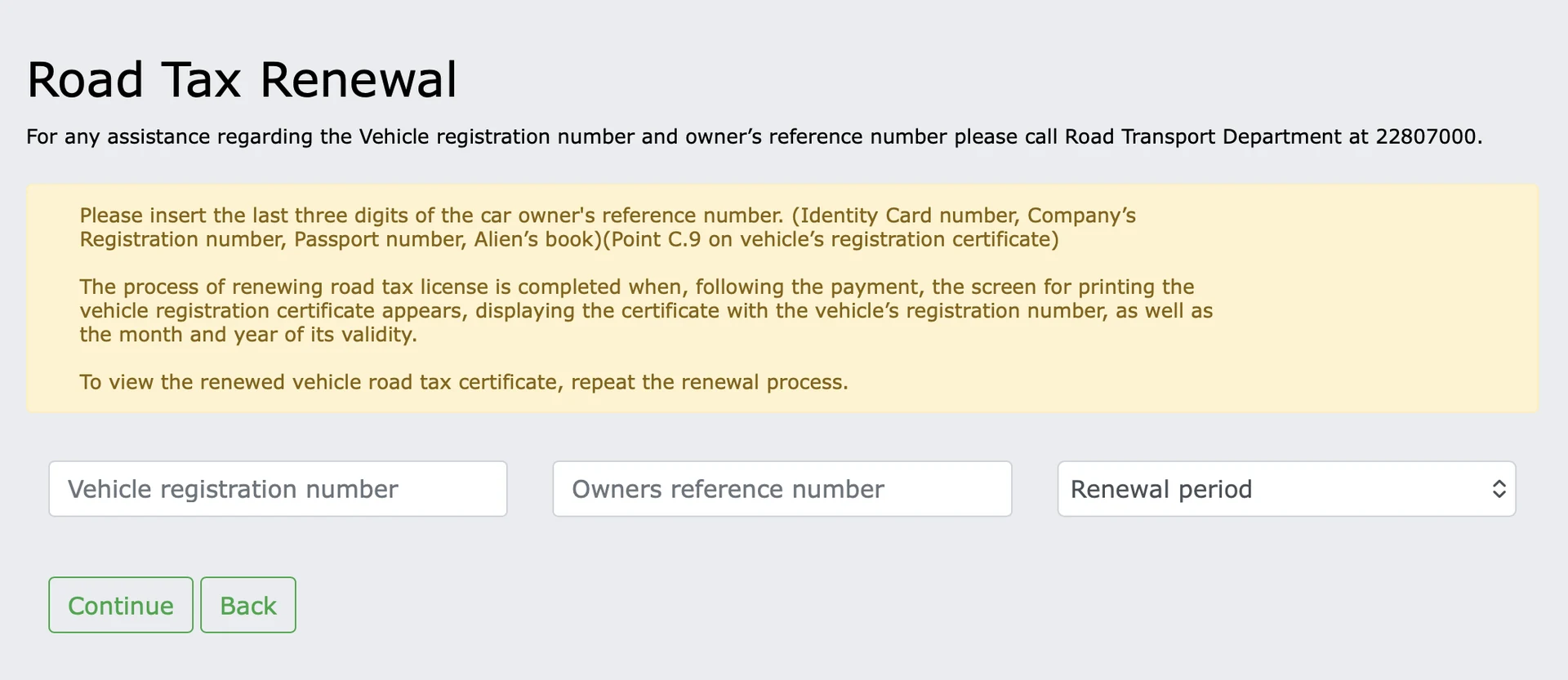
The vehicle registration certificate. Field C.9 holds the owner's document number. You won't need to type it in full, but you do need the certificate in front of you.
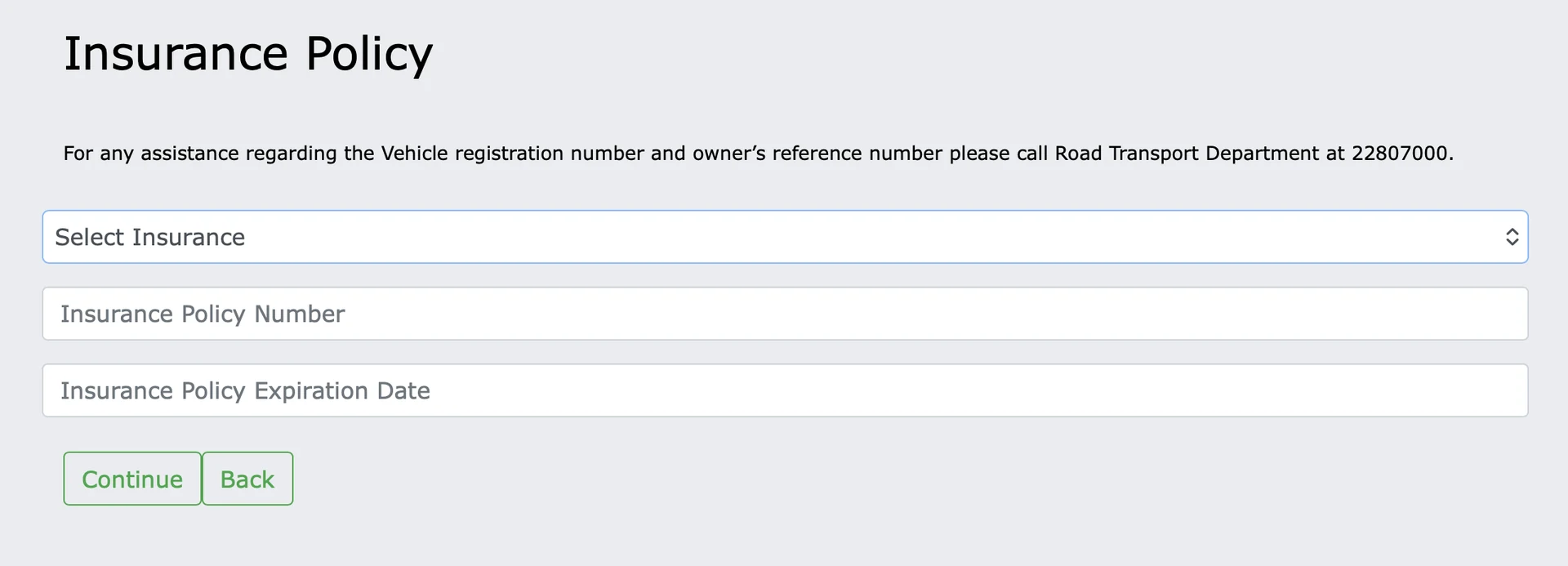
A valid insurance policy. You'll need the insurer's name, the policy number and its expiry date, all typed in by hand. If the policy has expired, even by a day, the renewal won't go through — sort the insurance first. We've written separately about motor insurance in Cyprus and what the different levels of cover actually mean.
A valid MOT. Without it the renewal won't go through either. When it's due depends on where the vehicle came from. One bought new from an official dealer in Cyprus is exempt for the first four years, then tested every two years. An imported vehicle is tested from the start, whatever its age, and every two years after that. A vehicle can be ten days old and still need an MOT.
A Visa, Mastercard or Maestro card. Keep your phone with your banking app next to you — you'll need to approve the payment.
If you used to pay through JCC
If you used to pay your road tax through JCCsmart and can't find it there any more, you're not imagining it. Road tax no longer goes through JCCsmart. It moved to the Road Transport Department's own portal, rtd.mcw.gov.cy.
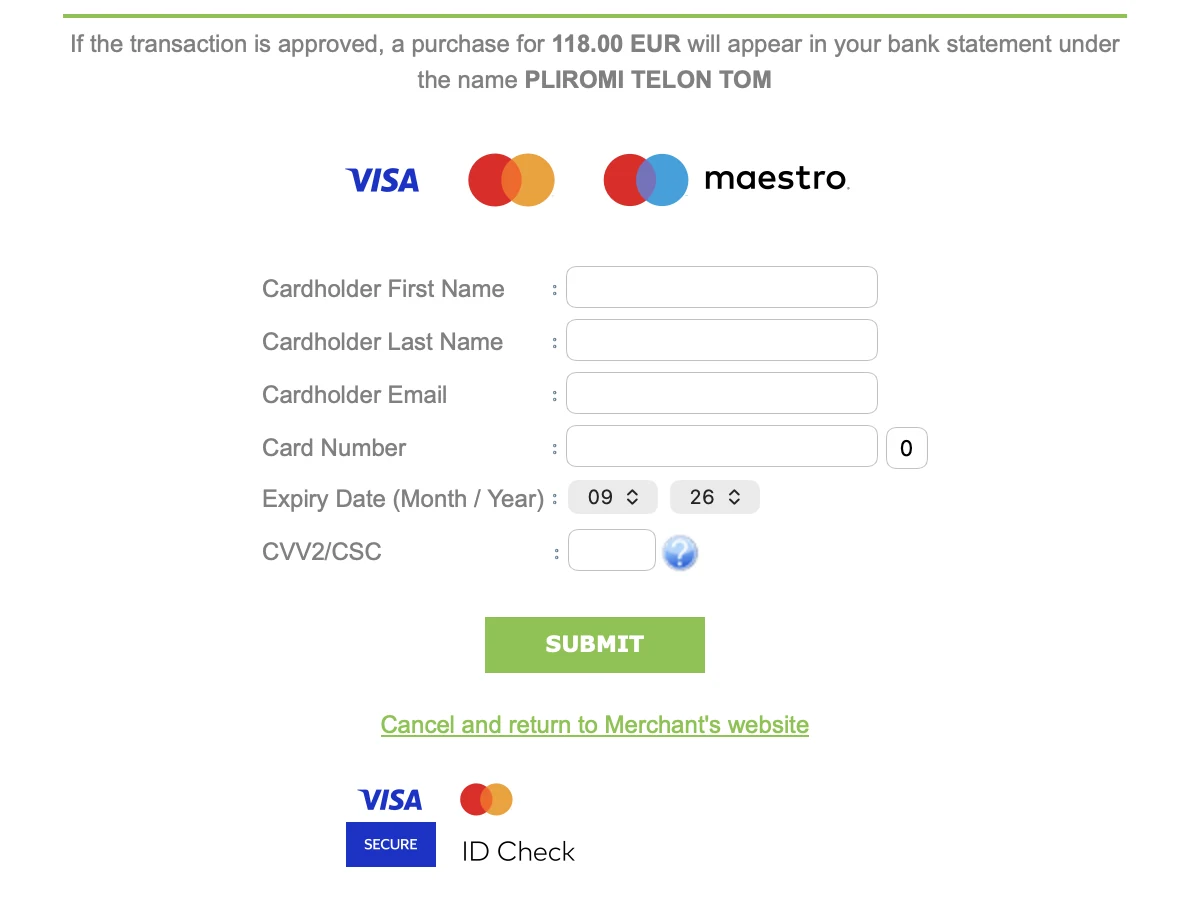
JCC hasn't disappeared from the process though, which is what confuses people. JCC handles card payments across Cyprus, so at the final step on the RTD portal you'll see the familiar JCC Gateway page with its logo. That's correct: RTD takes the application, JCC processes the card.
On your bank statement it shows up as PLIROMI TELON TOM. That's your road tax.
Old JCCsmart bookmarks no longer work — go straight to the RTD portal.
Paying on the RTD portal
The portal is in English and Greek. The eight steps are set out at the bottom of this page, with what you'll see on each screen.
If the payment fails, it's almost always because the payment session timed out. Either way you start again from the first screen. If money has left your account but you never saw the certificate screen, don't pay again blind — check your status first, as below.
Periods and the renewal window
The payment period runs in quarters to the end of the calendar year. The quarters are fixed: January to March, April to June, July to September, October to December. You can pay from the current quarter to the end of any later one, but never past December.
So how many options appear in the dropdown depends on the month. In January there are four: to March, June, September or December. Each quarter that passes removes one, and by October there's a single option left: to December. The portal isn't getting it wrong — that's how the charge works.
Paying in instalments costs around 10% more across the year than paying for the whole of it. On a €300 bill that's about €30.
People living in Cyprus permanently tend to pay straight through to December: it's cheaper and it's off your mind until next year. A shorter period makes sense if you're not sure you'll keep the vehicle, or you're planning to sell it this year. You're paying for the convenience of spreading it.
Road tax is first paid when the vehicle is registered, and renewed from that date on the same quarterly basis.
There are no windscreen discs any more. If you remember the old system, you're not missing anything — checks are done against the database, and objects on the windscreen are prohibited.
Fully electric vehicles are exempt from road tax.
The annual renewal window opens in January. The deadline falls in March, and it does get moved: in 2026 it was first announced as 11 March, then extended to 31 March. Work to March, but check the RTD announcements in January — last year's date may not hold.
Where else you can pay
You can also pay in person: at RTD district offices in Nicosia, Limassol, Larnaca, Paphos and Famagusta, at Citizen Service Centres (KEP), and at KEPO centres run by Cyprus Post. KEP are open 08:00 to 17:00 and take appointments only — turning up without one is a wasted trip. KEPO centres at the post office are open 08:00 to 14:30.
This is the route to take if you haven't got a card to hand, or the payment won't go through on the portal.
If you miss the deadline
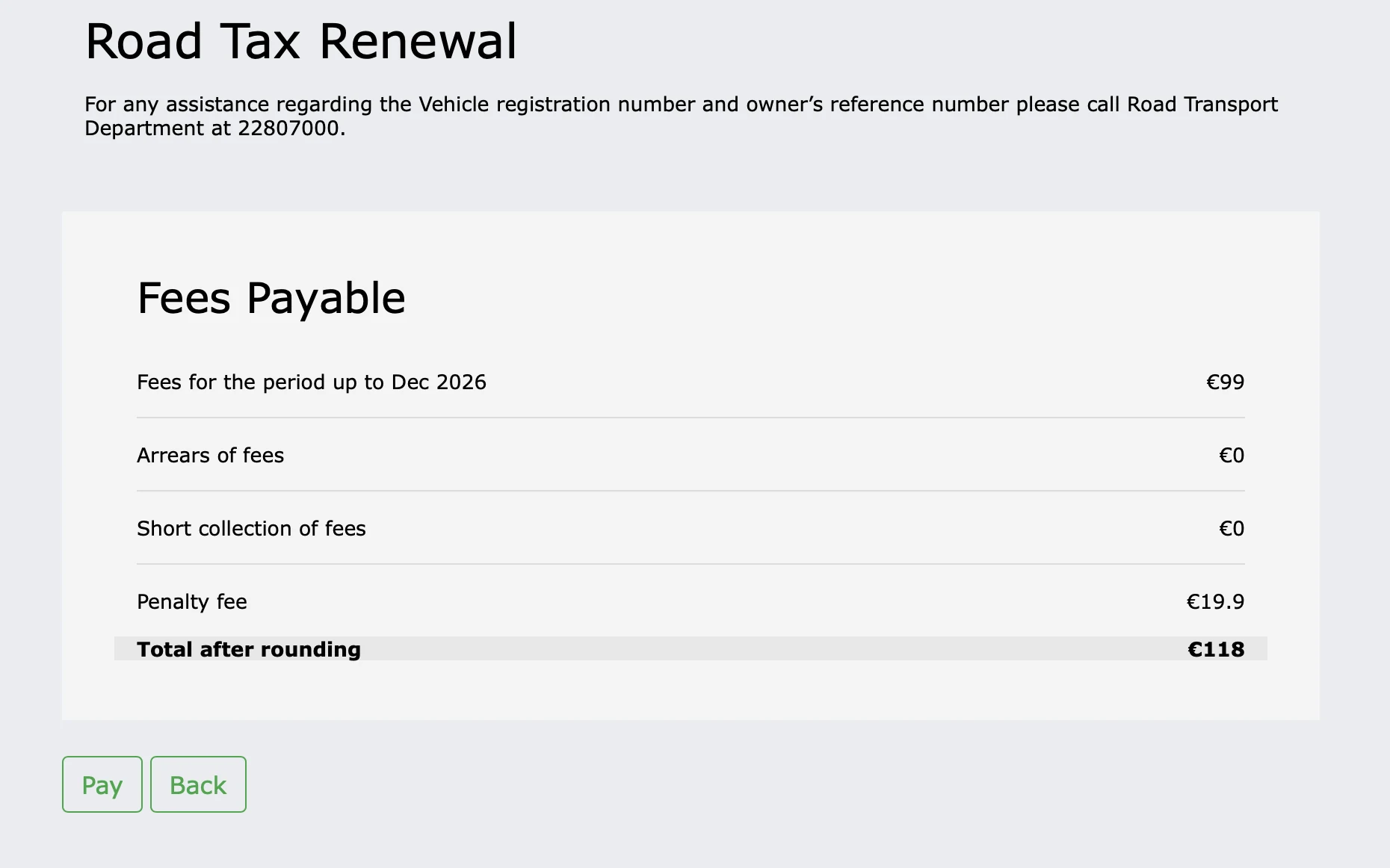
Being late costs immediately: a flat €10 plus 10% of the fee for the current year. You'll see it as a separate Penalty fee line on the payment screen, so the total will be higher than you expected. Arrears from previous periods show up there too, as Arrears of fees. It's all on one screen.
Then comes the part not many people know about. Leave the tax unpaid for a year and 70 days and the registration is cancelled — the vehicle comes off the register. That isn't a way out of the debt: the unpaid tax becomes a civil debt of the owner and still has to be settled. Meanwhile the vehicle is off the register and has to be registered again from scratch.
The year-and-70-days rule is set out on the RTD's own pages, along with the conversion of arrears into civil debt.
Separately from the department's charges there's a police fine: €150 for driving with unpaid road tax. That's on top of the €10 plus 10%, not instead of it — you'll still owe the surcharge when you renew.
The department doesn't send renewal reminders. It does let you subscribe to SMS alerts from the front page of the RTD portal, and it's worth doing that straight away.
Even if you're a long way behind, paying with the penalty costs less than waiting.
Checking your status online
There's no status button on the portal, but you can check in a minute.
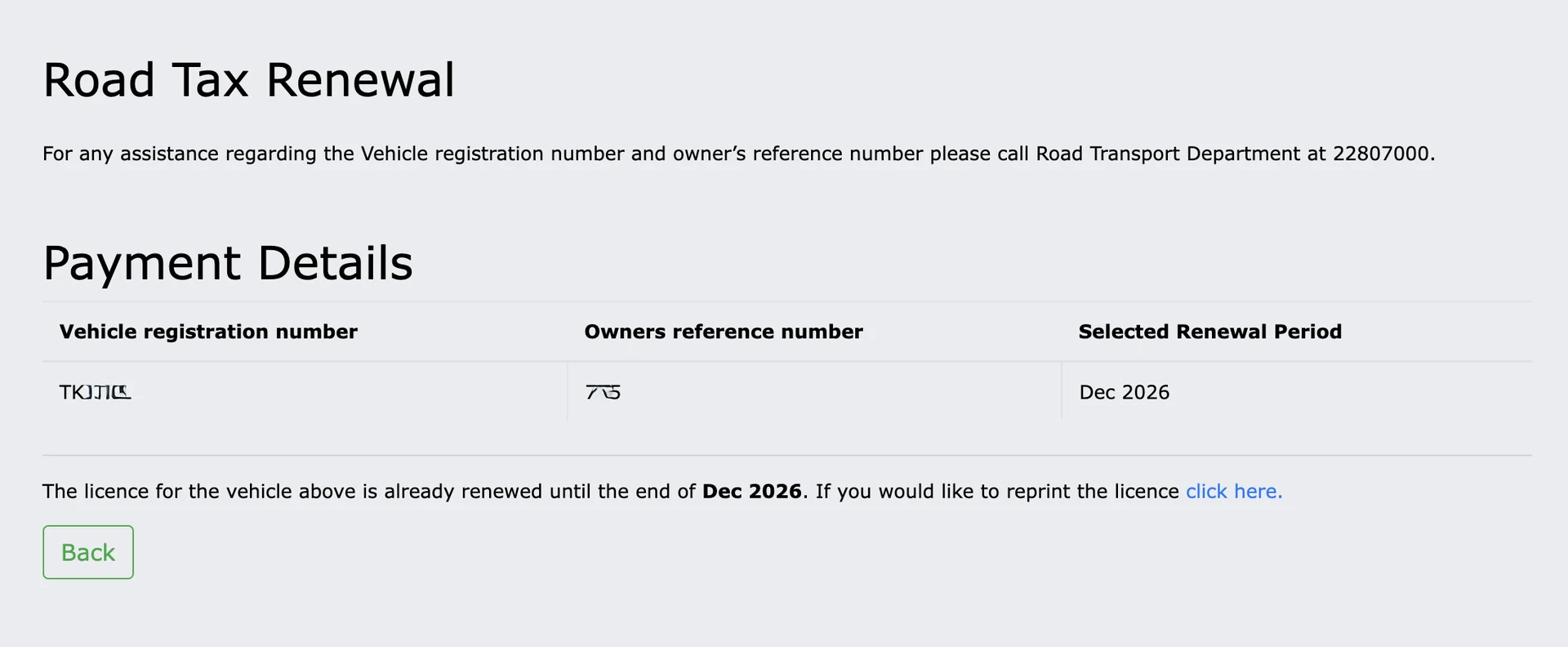
Go through the same route: open the renewal form, enter the registration number and the last three digits of the owner's number. If the tax is already paid, the system shows the current certificate with the month and year it runs to.
That's also how you get another copy of the certificate if you didn't save it — the print screen opens again and you can print it or save it as a file.
This is exactly what to do if money has left your account but you never saw the certificate print screen. If the certificate is there, the payment went through and you don't need to repeat it. If there's no certificate but the charge is on your statement, call RTD on 22807000 with the payment details.
It's worth checking the status before selling a vehicle, and before buying one privately: you'll see what month the tax is paid to, and whether you'll be renewing it the week after the sale.
If the vehicle isn't being used
If the vehicle isn't in use, you don't have to pay. Instead of the tax you file a declaration of non-use. The deadline is the same as for payment, and it can't be backdated.
How to file it, when it takes effect and what happens if you drive a vehicle that's been declared off the road — all in our guide to the RTD online account.
If you're still planning to bring a vehicle in
If you're still planning to bring a vehicle to Cyprus, work the road tax out before you buy — across different models the annual difference is noticeable. The road tax calculator gives you the figure for a specific vehicle, and our Telegram bot works out the full landed cost including customs and registration.