This guide covers the mechanics: which screens you will see inside the Road Transport Department account, and what to check before the money leaves your card. How bespoke plates work in Cyprus generally, and how an auction differs from buying one outright, is covered in our guide to bespoke registration numbers.
You cannot pick the letters — the department issues each series in turn. What goes under the hammer is the three digits inside it, and 13, 69 and 666 are never offered.
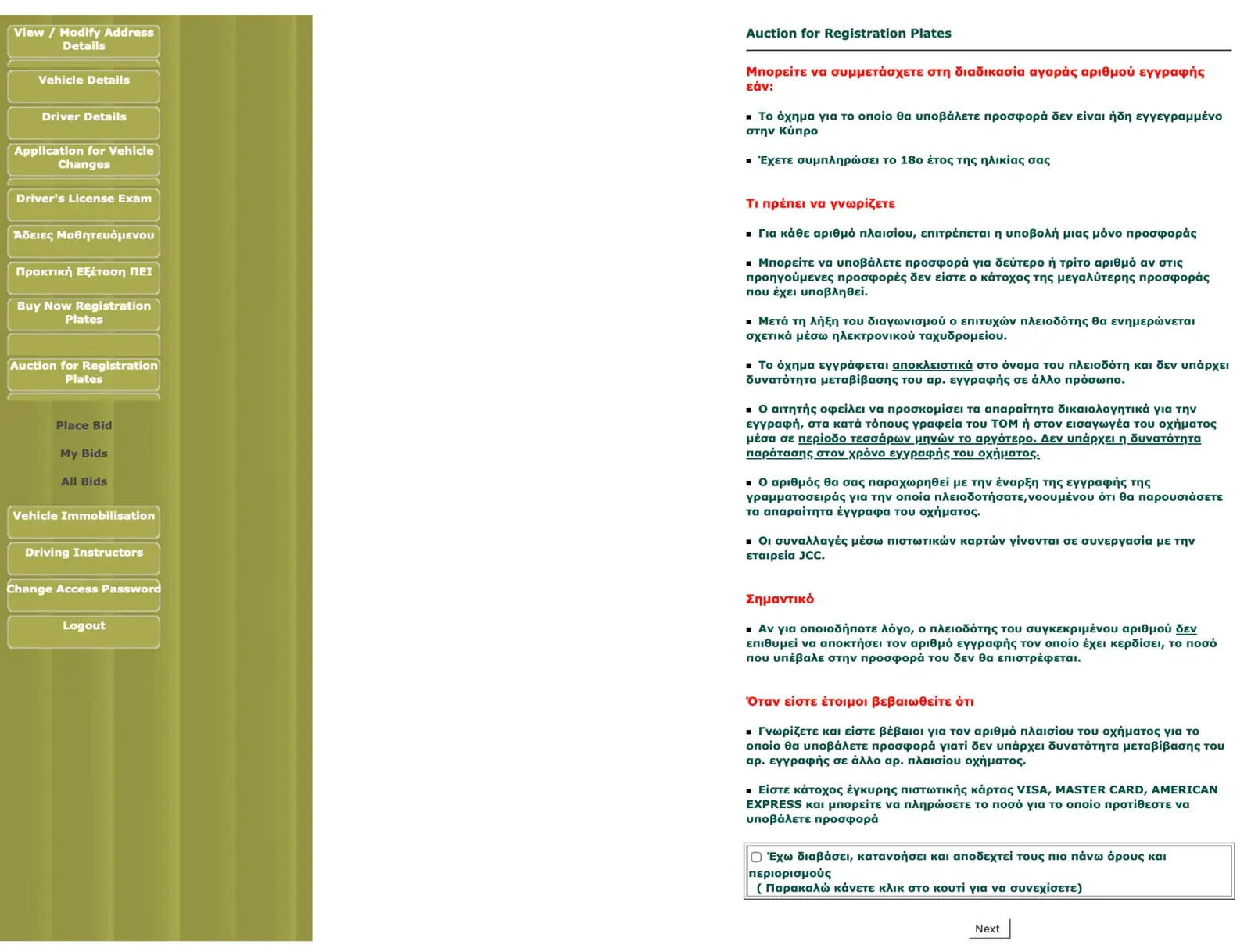
The auction terms are written in Greek and appear on a single screen before your first bid. They also spell out when your money comes back and when it does not, which is the part most bidders skip.
Who can take part
The portal lets you bid on two conditions: the car you are bidding for has not yet been registered in Cyprus, and you are over 18.
The first condition does the real work. A plate is auctioned against a car approaching its first registration here — new from a dealer, or imported. If yours already wears Cyprus plates the auction is closed to it, and no amount of bidding will change the digits.
What to have ready
Access to your RTD account. The auction sits inside it and there is no way in from outside. Getting access, including the routes open to people without a Cyprus licence, is covered in our guide to the RTD online account.
The VIN of the car you are bidding for. It has to match character for character. A winning plate cannot be moved to a different chassis number afterwards. If the car is still in transit, take the VIN from the purchase paperwork and check it twice.
A card carrying the full amount. The money goes at the moment you bid, not when the auction closes. If someone outbids you it comes back, but it has to be there first. The JCC payment page takes Visa, Mastercard, and Maestro.
A ceiling decided in advance. You cannot raise your own bid while it leads, so the figure you type is the one you live with until somebody beats it.
Bidding on the RTD portal, step by step
The menus and the bidding screens are in English. The terms and the final confirmation are in Greek. Here is what each screen asks for.
1. Sign in to your RTD account. In the left menu open Auction for Registration Plates and choose Place Bid.
2. The Greek terms screen opens. Read it, tick the box at the bottom, and press Next. The parts worth knowing are unpacked in the next section.
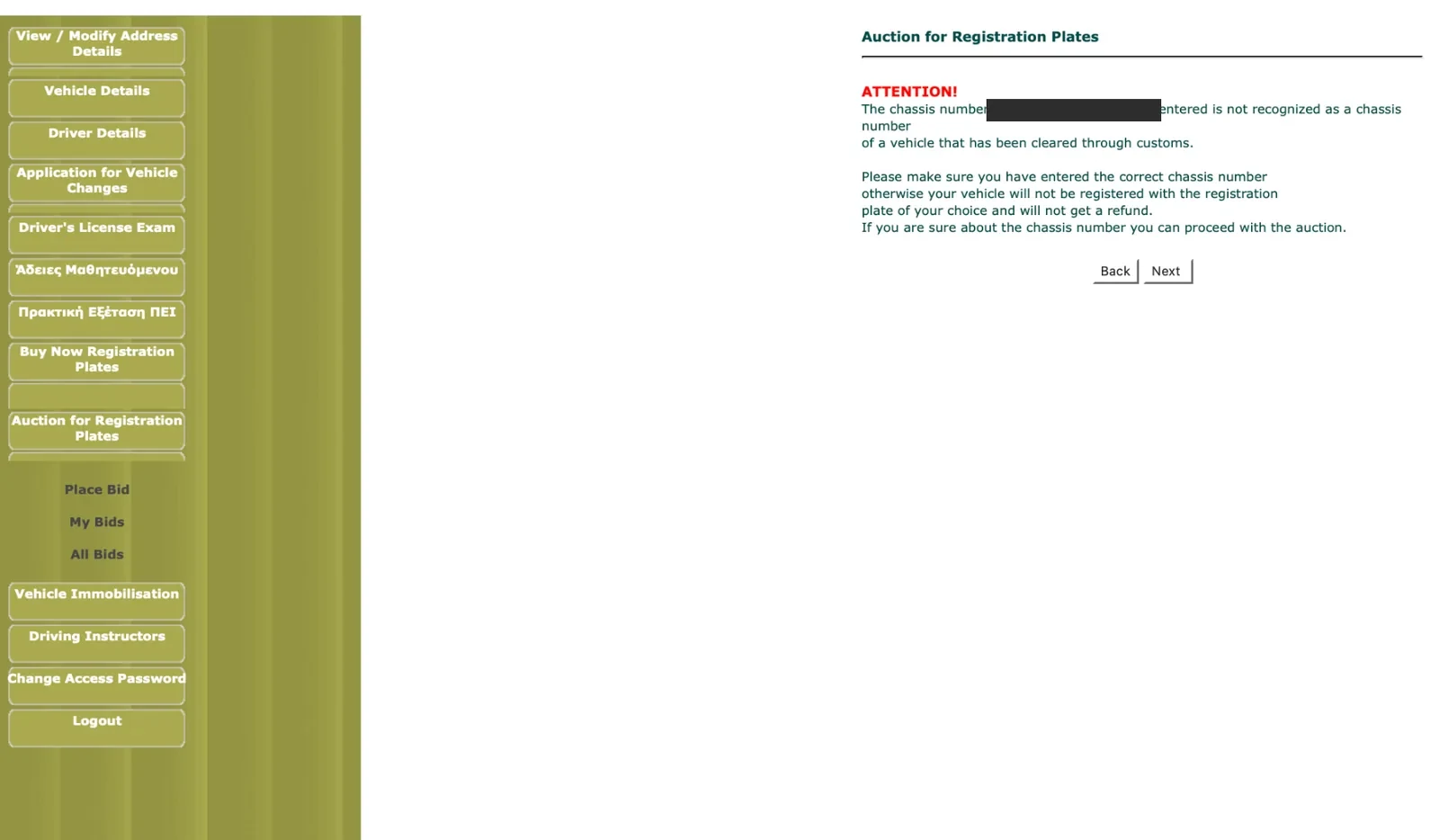
3. Enter the chassis number. If the system cannot find that VIN among cleared vehicles it shows an ATTENTION warning. It does not block the bid: if the car has simply not cleared customs and you are sure of the number, press Next. But a typo means the plate never attaches to the car, and the money is gone.
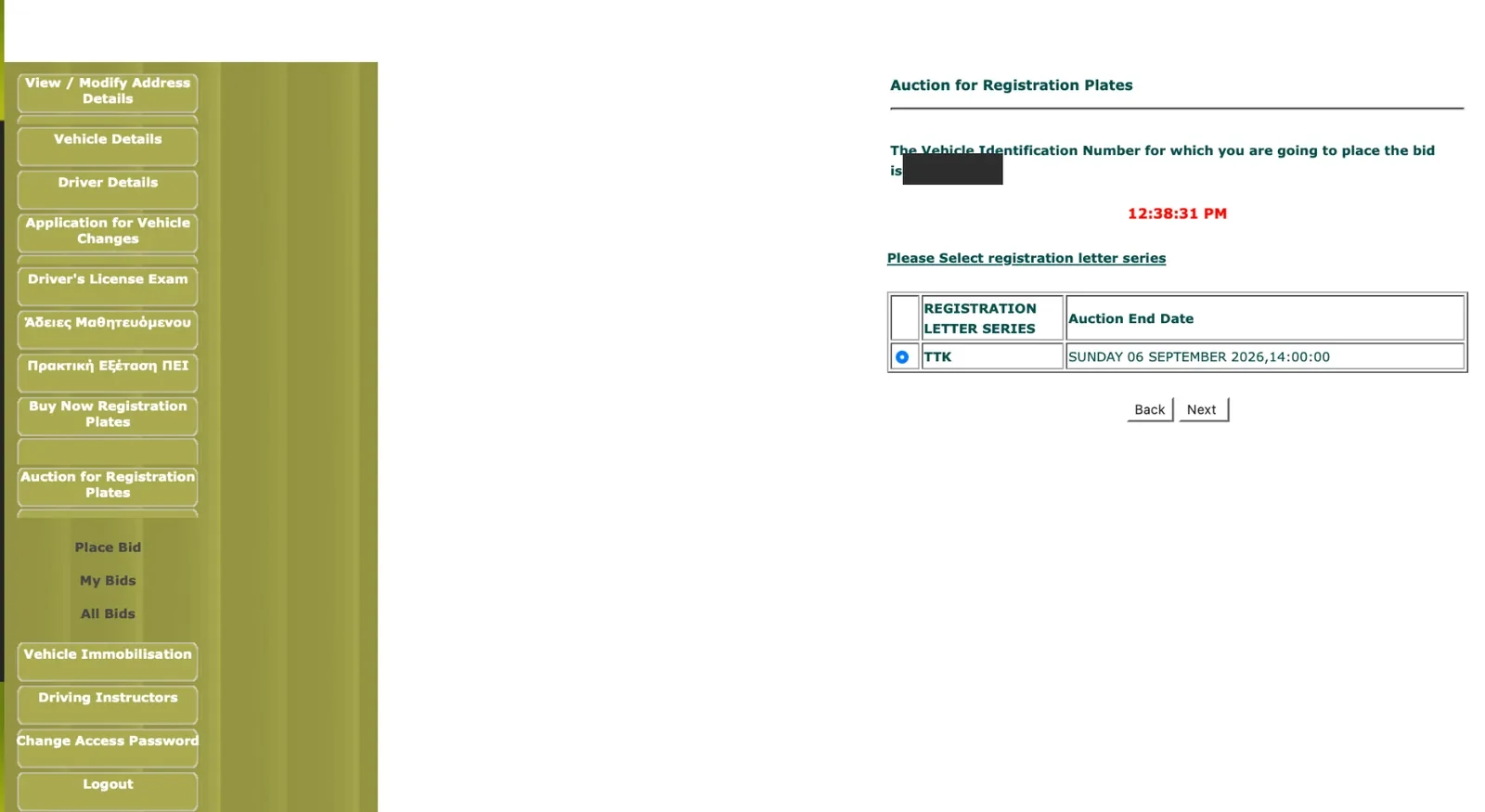
4. Pick the letter series. The table shows the series currently open, with the date and time the auction closes. Select it and press Next.
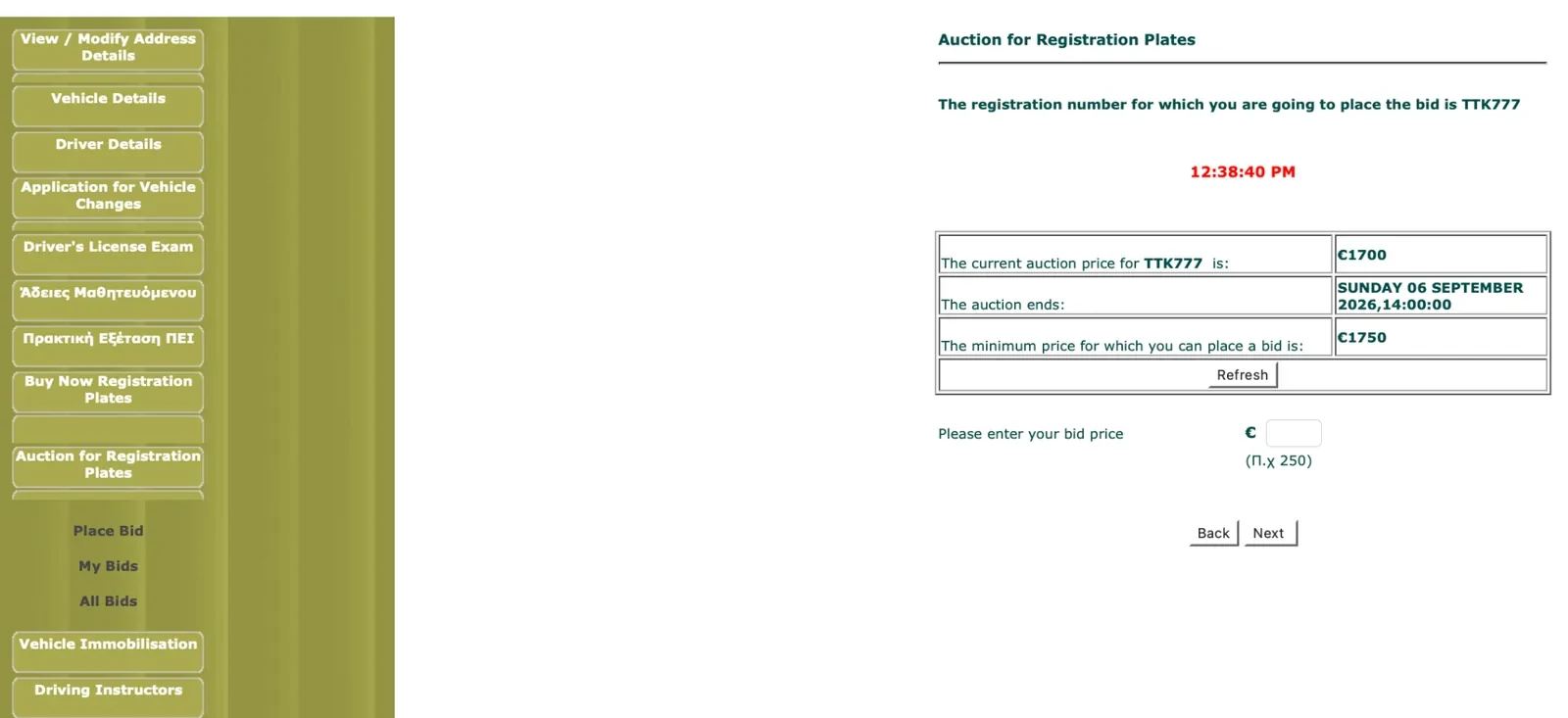
5. Choose your digits. The next screen shows three lines: the current price, when bidding ends, and the minimum bid — always €50 above the current price. Refresh updates the price if the auction is moving. Type your amount into Please enter your bid price and press Next.
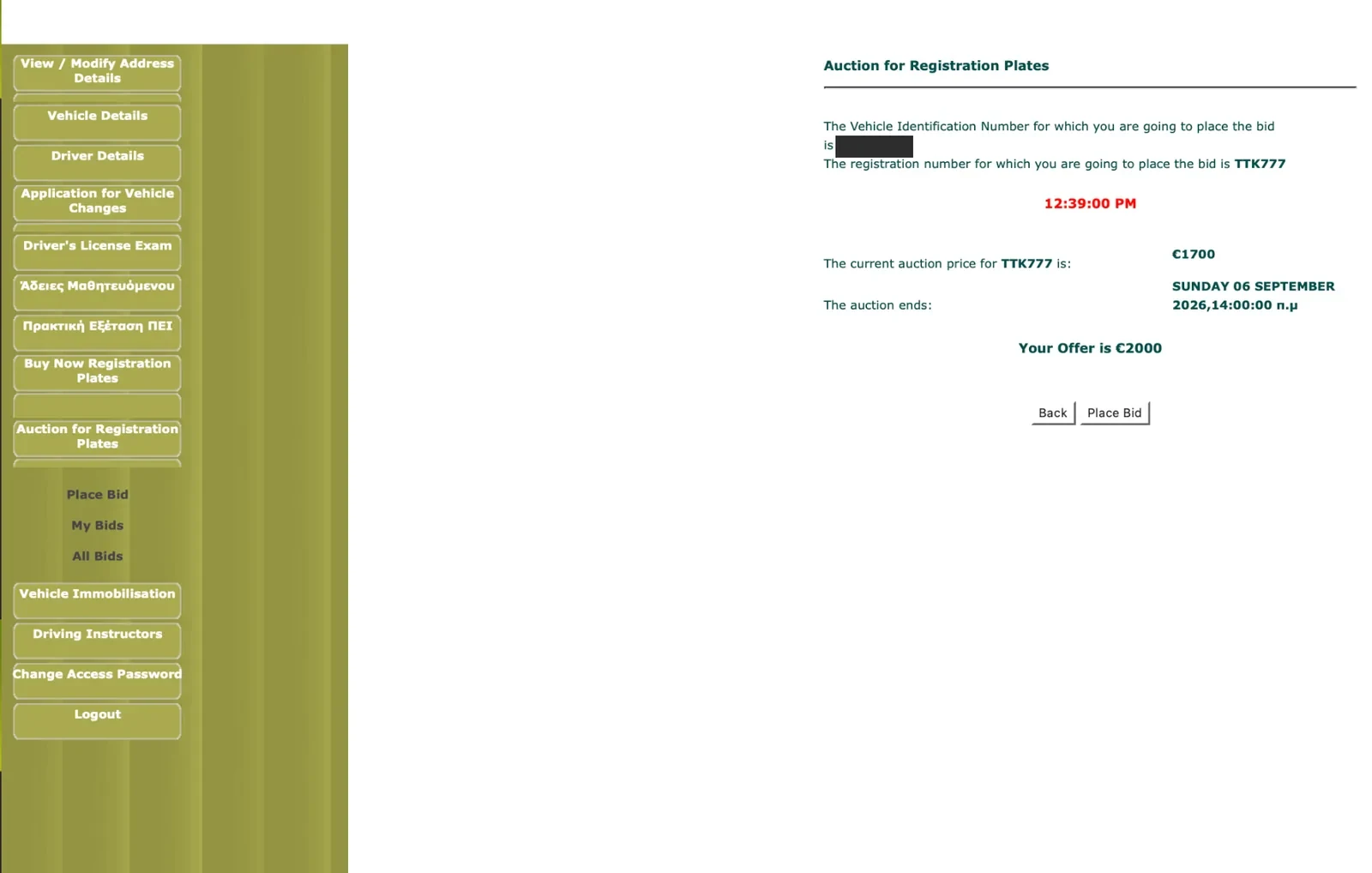
6. Check the confirmation screen: VIN, the number, the current price, and your own figure on the Your Offer line. If it all reads correctly, press Place Bid.
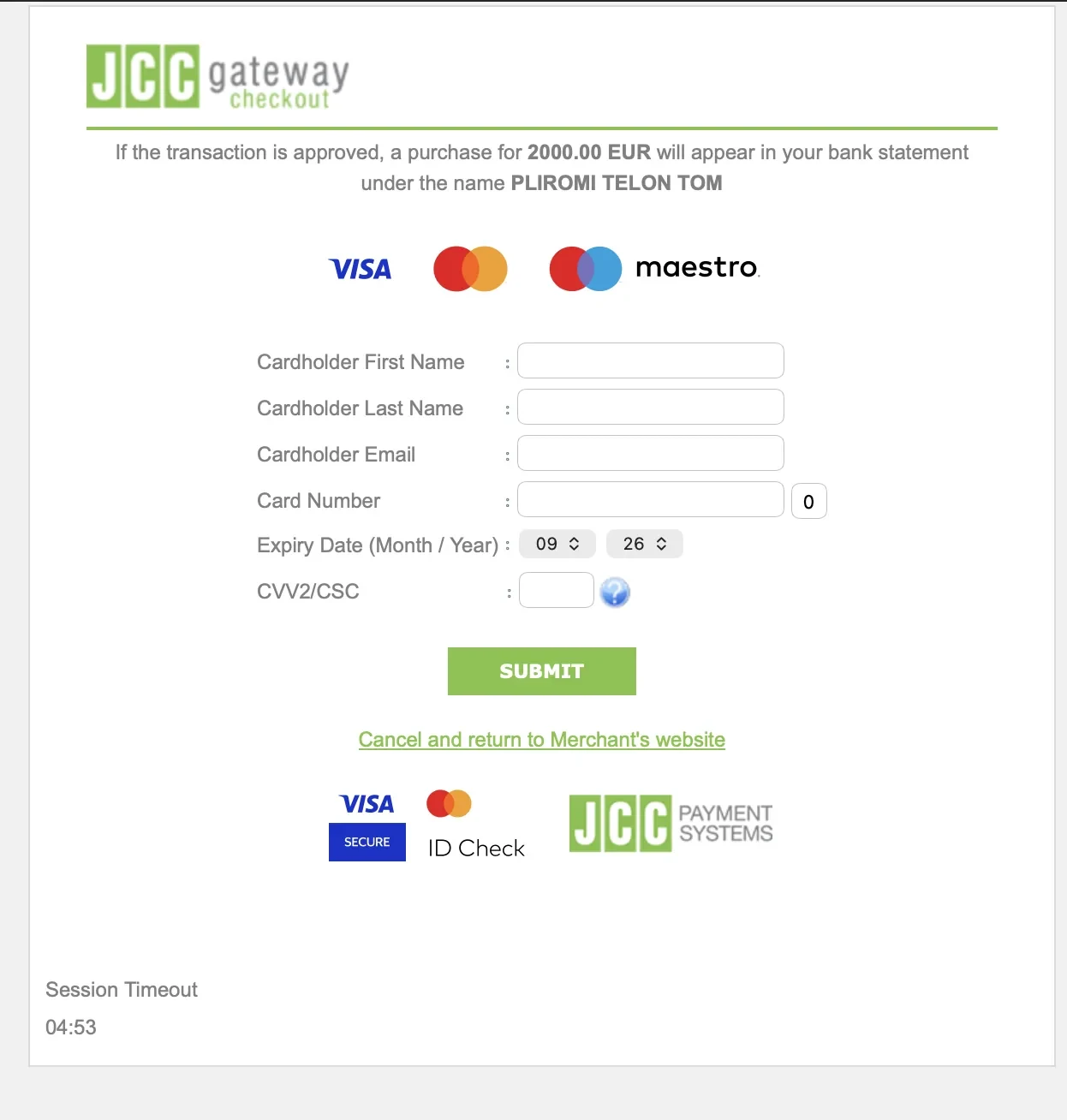
7. The JCC Gateway payment page opens — the same one used for paying road tax. This is the JCC payment gateway, not the JCC Smart service that no longer handles road tax. Your full bid is debited and appears on the statement as PLIROMI TELON TOM. You have roughly five minutes to enter the card details, with a timer running at the bottom of the page.
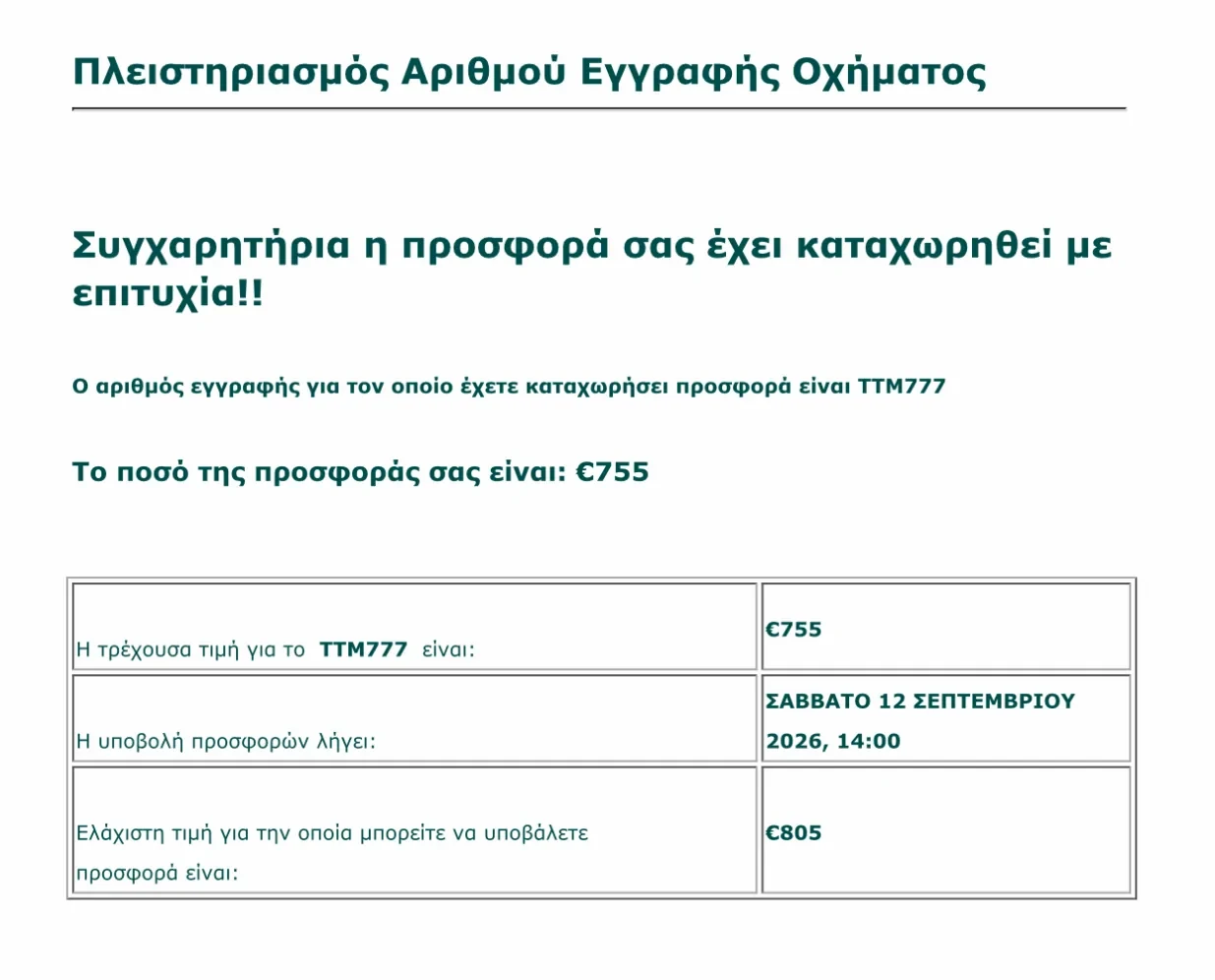
8. Wait for the Greek screen reading «Συγχαρητήρια η προσφορά σας έχει καταχωρηθεί με επιτυχία». Your bid is in. The screen carries the number, your amount, the closing date, and the new minimum for everyone else.
Terms worth reading before you bid
What follows is the substance of the auction terms, plus what the process teaches you once you have been through it.
The plate registers to the bidder alone and cannot be passed on. You can transfer the car later and the plate travels with it. But if the car is meant for someone else from the outset, let them bid from their own account.
One bid per VIN, and you cannot change it until you are outbid. Once that happens you are free to bid again — on the same number or a different one. The terms allow bids on a second and third plate.
The winner is emailed at the address registered on the portal, once bidding closes.
Four months to register the car, counted from the close of the auction. There is no extension. The closing date sits on the series selection screen, so count from there. Within that window the paperwork goes to a district RTD office or to whoever imported the car. For an imported car this is the real risk: if shipping or customs run long, nobody moves the deadline.
The plate itself arrives when the series starts being issued, and only against the car's documents. Not before, even if the car is already on the island.
Walk away from a plate you won and the money stays where it is. No refund, whatever the reason.
When the auction is open
Bidding does not run continuously. The department auctions the plates of one letter series shortly before it starts issuing that series. When bidding closes, the portal's front page announces that registration has opened for it. If nothing is currently up for auction the front page says so: There is no available auction series.
Series follow one another. In September 2026 bidding on TTK closed on the 6th, on TTM on the 12th, and on TTN on the 18th.
Buying a plate outright for €100
Thirty minutes after bidding closes, whatever is left in that series can be bought directly, no bidding involved, at a flat €100. Auction ends at 14:00, direct sales open at 14:30.
Worth doing even if a memorable number means nothing to you. Skip it and registration hands you a random combination from the current series. For €100 you pick the digits yourself, and avoid the ones you would rather not drive around with.
In your account it is Buy Now Registration Plates, in the same menu as the auction. The steps mirror bidding, payment runs through JCC the same way, only the amount is fixed.
Both services are listed in the official gov.cy catalogue: bidding at auction and buying a plate. The entries simply point back to the RTD portal — the two sites are not integrated.
If your car is commissioned to Cyprus through isellcars.cy, we will handle the auction with you. The cleanest route is your own portal account: you bid, we check the digits and line the closing date up against delivery. Where an account cannot be opened we bid in the company's name, register the car to ourselves, and transfer it to you. For our clients this costs nothing beyond the bid. More on our bespoke registration plates page.