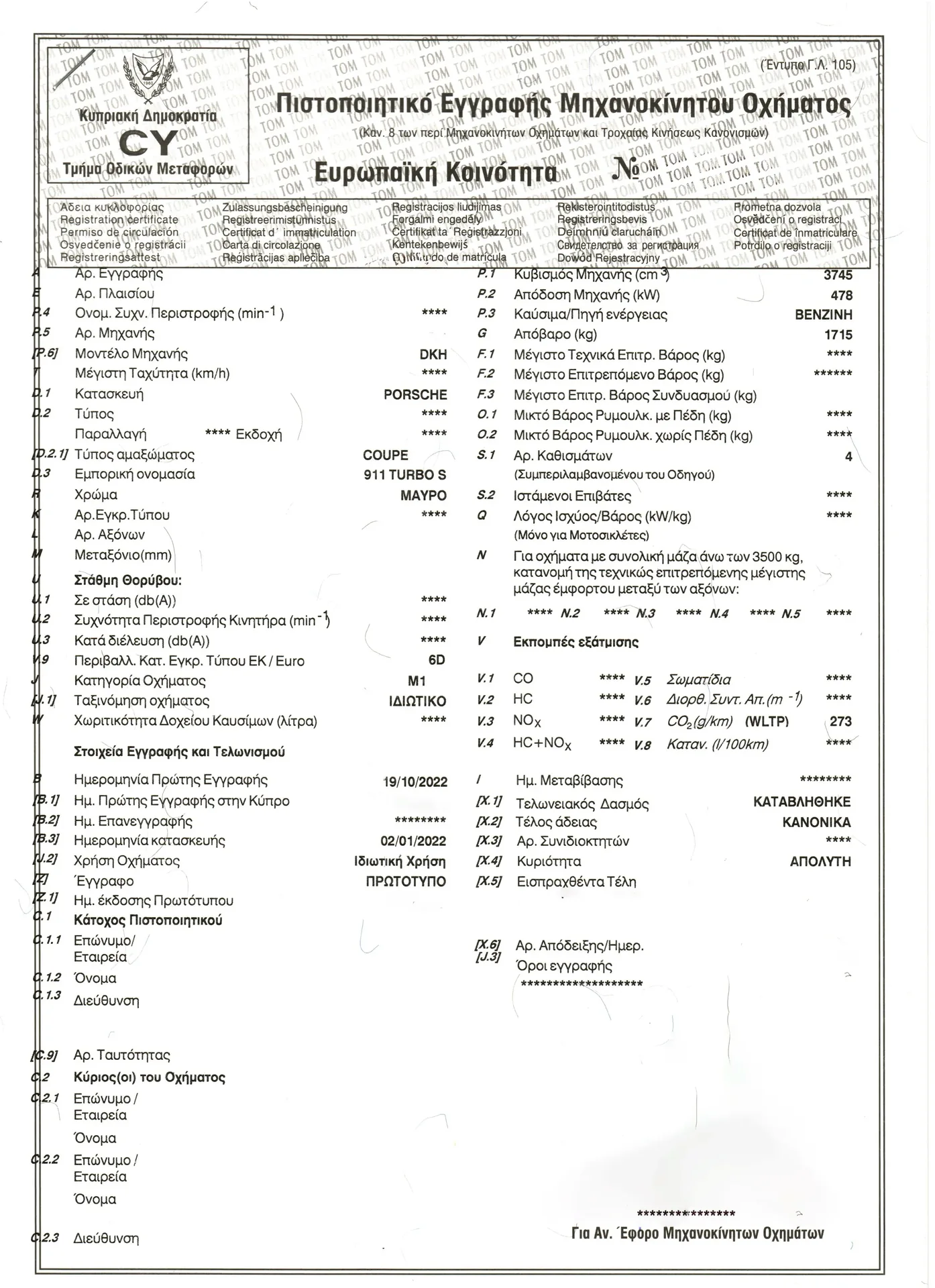
Transferring a registered vehicle in Cyprus takes about fifteen minutes at the counter and costs €8.54. Almost nobody gets it done in one visit the first time.
The reason is that the process has three separate gates — the paperwork you bring, the vehicle's condition, and the way the form itself is filled in — and failing any one of them sends you home. This guide covers all three, in the order that matters.
The short version
Both parties go to a Road Transport Department office or a Citizen Service Centre with the original logbook, insurance in the buyer's name valid more than three months, and Form TOM 9 completed in capital letters with no corrections. It costs €8.54, and the new registration certificate is printed at the counter before you leave.
Or skip it entirely. An agent handles the whole transfer for around €50 including the government fee, using their standing daily slot at the Road Transport Department. No visit, no queue, no appointment hunt. Details below.
What stops a transfer: an expired MOT, road tax arrears, or an open manufacturer recall. Check those three first — no agent can work around them.
Before you go: what blocks a transfer
Check these before you arrange anything else. Each one stops the transfer regardless of how good your documents are.
- Expired MOT. The vehicle needs a valid roadworthiness certificate. An expired MOT blocks the transfer.
- Road tax arrears. Road tax must be current. If the vehicle has been declared off the road, the outstanding amounts have to be settled first.
- A pending manufacturer recall. Since February 2025 the Road Transport Department requires recall status to be established before a transfer. If a recall is outstanding, you cannot obtain the clean certificate — you deal with the recall or you use the acknowledgement route described below.
- Outstanding finance or encumbrance. If the vehicle is subject to hire purchase or is pledged, that appears in the ownership section of the form and affects what can be transferred.
Sort these first. Everything below assumes the vehicle's record is clean.
Proof of identity
What you need depends on how long you have been in Cyprus.
- Under six months: a passport is normally sufficient, together with proof of your arrival date — a flight ticket, or the entry stamp in your passport for non-EU nationals.
- Over six months: you will normally be asked for a valid Alien Registration Card (ARC) or Cyprus residence permit.
The form itself accepts a range of identifier types, each with its own code: company registration number (0), Cyprus ID (1), passport (2), diplomatic ID (3), military ID (4), alien registration card (5), British Bases ID (6), and United Nations ID (7). Enter the code that matches the document you are presenting.
If the seller is a company, the form requires the company registration number, plus the stamp and signature of an authorised director.
Insurance — and the detail most guides get wrong
You will read in a lot of places that a cover note is enough. Be careful with that.
The note printed at the bottom of Form TOM 9Γ requires the insurance certificate to have an expiry date more than three months after the date of transfer, and the policy must be in the buyer's name. A short-term cover note running fifteen or thirty days does not satisfy that on its face.
In practice cover notes are frequently accepted, particularly where the insurer has issued one specifically for the transfer with the required validity. But the requirement printed on the form is a certificate with more than three months to run. If you want a single visit rather than two, arrange insurance in the buyer's name with at least three months of cover and bring the certificate.
Form TOM 9
The transfer of ownership of vehicles in Cyprus is made on Form TOM 9 (current version TOM 9Γ), issued under Regulation 14(2) of the Motor Vehicles and Road Traffic Regulations of 1984.
The form records:
- Vehicle details — registration number, make, type.
- Seller's details — identifier type and number, full name, address, postcode, telephone.
- Buyer's details — the same, plus date of birth, whether the buyer is over or under 18, and both a residential and a correspondence address.
- Insurance details — insurer, policy document number, expiry date.
- Type of ownership being transferred — absolute owner, hire-purchaser, co-owner, as security, or as a pledge. Tick one.
Three procedural rules that cause rejections:
- Complete it in capital letters.
- No corrections and no correction fluid. The form states explicitly that if it contains errors or corrections, or if correction fluid has been used, it will not be accepted. Print a fresh copy rather than fixing a mistake.
- Both signatures must be certified. The form has two certification boxes — one for the seller's signature, one for the buyer's — to be stamped by a Community Leader (Mukhtar) or a Certifying Officer. If both parties attend the Road Transport Department or a Citizen Service Centre together with their identification, an officer there can certify on the spot at no separate charge. If one party cannot attend, get the signature certified in advance by a Mukhtar, who charges a small fee.
The vehicle registration certificate
The original registration certificate must be presented with the form. Officially it is the Πιστοποιητικό Εγγραφής, which is how it appears on the paperwork; in everyday speech in Cyprus everyone calls it the kotsáni (κοτσάνι). If a seller or a mechanic uses that word, this is the document they mean.
It is listed on the form's own note alongside the insurance requirement, and it is a frequent cause of wasted trips — sellers often assume the buyer already has it, or that a photocopy will do. It must be the original.
Recall documents
This is the newest part of the process and the part that changes most often. It exists to apply Regulation (EU) 2018/858 and the Cyprus Vehicle Type Approval Law of 2005 as amended.
There is a family of four forms. Which one you need depends on the vehicle's origin and its recall status.
Form TOM 369 — Certificate of no pending recalls
For vehicles first registered in Cyprus and supplied through the manufacturer's official distributor or authorised dealer. It is completed and stamped by that distributor, who confirms two things: that no recall is outstanding for that chassis number, and that the vehicle has been entered into the distributor's database so the owner will be notified of future recalls.
That second condition is why the form only works for cars that came through the official Cyprus network. A parallel import that happens to have been first registered in Cyprus will not be on the distributor's system, so the certificate cannot be issued and you use TOM 371 instead.
The form carries the chassis number, the registration number where applicable, the distributor's name and company registration number, the name of the person completing it, and the company stamp.
Note the scope: the certificate is presented by the person registering, transferring, or having the vehicle technically inspected. It is not a transfer-only document — it applies at MOT as well.
Form TOM 371 — Recall declaration for transfer and technical inspection
For imported vehicles and any case where a distributor certificate is not available. This is a self-declaration, and it has two options — most guides only mention the first.
The declarant states that they have carried out all relevant recall checks via the internet and other information sources, and then ticks either:
- no recall is pending — with the supporting documentation attached; or
- it was not possible to find information on pending recalls, either because there is no manufacturer or because there is no known recall procedure.
Option (ii) matters. For a Japanese domestic-market import, a defunct marque, or a vehicle whose manufacturer runs no accessible recall lookup, you are not stuck — you declare that the information could not be found, and the process continues.
By signing, the declarant also undertakes two ongoing obligations: to keep themselves informed at regular intervals about recalls and apply corrective measures if any are found, and to accept responsibility for use of the vehicle in relation to risks arising from a recall.
Who signs: on a transfer, the buyer. On a technical inspection, the owner.
The current version of the form is dated 11 February 2025.
Form TOM 372 — acknowledgement of a pending recall
What happens when the vehicle genuinely does have an open recall.
You are not stuck. The buyer signs Form TOM 372, acknowledging that a recall is outstanding and accepting the vehicle on that basis, and the transfer proceeds.
This is the case most guides leave as a dead end. An open recall is not a reason the car cannot change hands — it is a disclosure the buyer signs for. Whether you want to buy a car with an unresolved safety recall is a separate question, and worth asking the seller why it has not been done, since the work is normally free at a franchised dealer.
Form TOM 370
A fourth form in the same family, used for recall checks at registration of vehicle rather than transfer.
First registration in the RTD system
If this is your first vehicle in Cyprus, your personal details have to exist in the Road Transport Department's system before a vehicle can be put in your name. You will be asked for:
- an original identification document;
- your residential address;
- a contact telephone number.
This is a one-off. Once you are in the system, later transfers are considerably quicker.
Where to go, what it costs, who attends
The transfer is submitted in person at a district Road Transport Department office — Nicosia, Limassol, Larnaca, Paphos or Ammochostos — or at a Citizen Service Centre (KEP).
Buyer and seller both attend, or one is represented by proxy or by a lawyer holding a power of attorney. Where one party is absent, their signature must have been certified in advance.
The standard transfer fee is €8.54, payable at the counter. Additional charges can apply where customs duties on the vehicle have not been settled.
Where both parties attend in person with complete paperwork, the new registration certificate is printed at the counter and handed to you before you leave. You do not wait for it in the post. If the file is submitted remotely rather than in person, expect to collect it on a later visit.
Number plates stay with the vehicle.
Using an agent
You do not have to set foot in the Road Transport Department or a Citizen Service Centre. Agents and service companies handle vehicle transfers as routine work, and for most people they are worth the money.
Typical cost is around €50 including the €8.54 government fee — so roughly €40 for the service. Treat that as indicative rather than fixed; it varies by agent and by how complicated the case is.
What you are actually paying for:
- No visit, no queue. Agents hold standing daily or weekly slots at the Road Transport Department. You hand over the documents, they file it and collect the new registration certificate for you. Doing it yourself means either queuing or waiting for an appointment.
- The form filled correctly. No correction fluid, capital letters, right identifier codes, right ownership category. They fill in dozens of these a month; the rejection rules that catch first-timers do not catch them.
- Knowing which recall form applies. Whether your case needs TOM 369, TOM 371 with option (i), or TOM 371 with option (ii) is not always obvious, and getting it wrong means starting again.
- Acting when one party can't attend. Working under a power of attorney, an agent removes the need to coordinate two people's diaries around government office hours.
On signatures: if nobody attends the RTD or KEP in person, the two signatures on Form TOM 9 still need certifying by a Community Leader (Mukhtar) or Certifying Officer, or the agent acts under a power of attorney. Either way it is one short errand rather than a morning at a government counter. Ask the agent which route they want before you sign anything.
When it is clearly worth it: an imported vehicle, a seller who has already left the country, a first registration where you are not yet in the RTD system, or simply a week where you cannot spare a morning.
One thing an agent cannot do is fix the vehicle's record. They still need the seller's original logbook, and they cannot conjure a valid MOT or clear road tax arrears. Sort those first either way. The agent may file for a replacement of original logbook, if misplaced, simultaneously with the transfer.
After the counter
Check the new registration certificate before you leave the counter. Confirm the chassis number, engine details and your name and address are correct — corrections are far easier at the desk than afterwards.
Tell your insurer the transfer is done and send them the new certificate, so the policy is issued against the right registered owner.
And note where liability sits in the meantime: until the change is recorded in the RTD system, the seller remains the registered owner, which means traffic violations, fixed penalties and road tax continue to attach to them. That is a reason for the seller to push for prompt completion, not just the buyer.
One more thing you may be asked at the counter: whether you own any other vehicles. If you do, be ready to produce their registration certificates.
Full checklist
Before you go to the Road Transport Department or KEP:
- Passport, or valid ARC / residence permit
- Proof of arrival date, if you have been in Cyprus under six months
- Original vehicle registration certificate (logbook)
- Insurance certificate (cover note) in the buyer's name, valid more than three months beyond the transfer date
- Valid MOT certificate
- Road tax current, with any arrears settled
- Form TOM 9, completed in capital letters, no corrections, both signatures certified
- Recall documentation: TOM 369 for a vehicle supplied through the official Cyprus dealer network, TOM 371 for an imported one, or TOM 372 if a recall is outstanding and the buyer is proceeding anyway
- €8.54 for the fee
- Original ID, address and telephone number, if this is your first registration in the RTD system
What actually goes wrong
Almost every failed first attempt comes down to one of four things: a cover note instead of an insurance certificate with more than three months to run, the seller's original logbook left at home, a signature nobody certified, or correction fluid on the form.
None of them is difficult. All of them cost you a second morning.
Get those four right, and confirm the MOT, road tax and recall status before you arrange anything else — then it really is fifteen minutes and €8.54, with the certificate in your hand before you leave the counter.
Buying a car you can't find on the island? We source and import vehicles from the UK, Japan and Australia and handle customs, registration and the transfer paperwork end to end. Talk to us about a commissioned import.