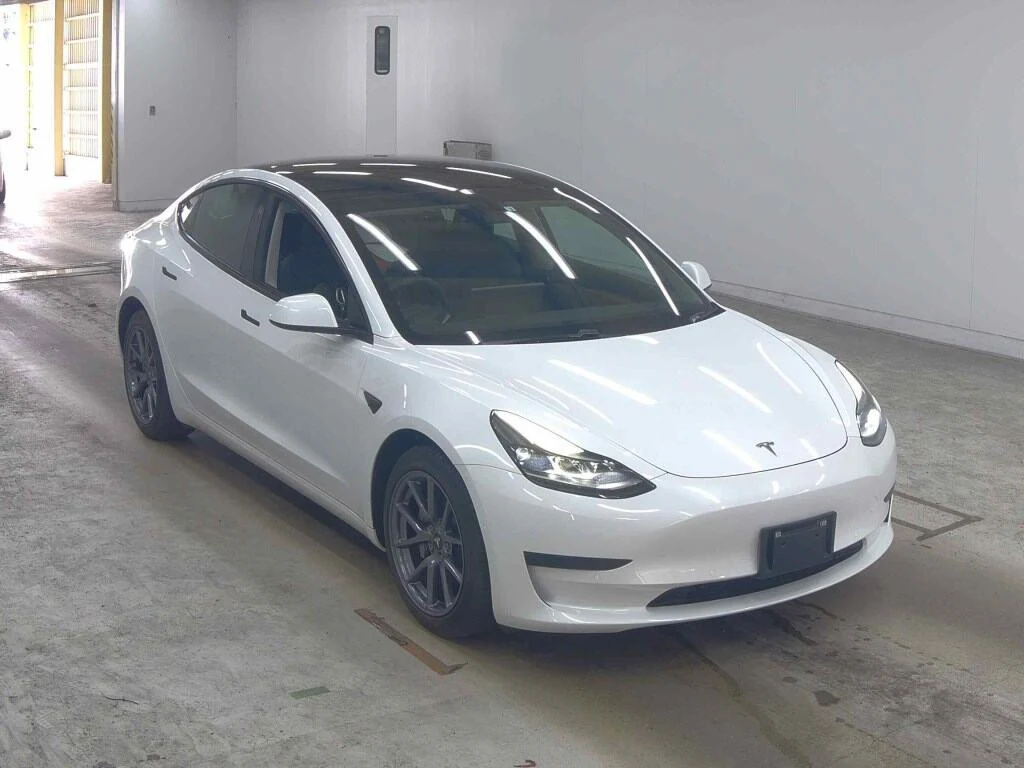
A Japanese Tesla will usually be several thousand euros cheaper than the European equivalent, with lower mileage and better cosmetics. That part is real and it is why so many arrive here.
What decides whether it was a good buy is one specification detail that does not appear in any photograph, and a handful of documents most sellers never mention. Get those right and a Japan-sourced car is an excellent purchase. Get them wrong and you own a Tesla that cannot use half the island's fast chargers.
Why the Japanese cars are cheaper
It is not a quality story. Japan's domestic market treats used cars harshly on price: the shaken inspection regime gets expensive as a car ages, annual mileage is low, and the closed auction system moves enormous volume every week. Cars leave that market cheap and in good condition because the domestic demand for them has fallen away, not because anything is wrong with them.
Add right-hand drive, which Cyprus requires, and Japan becomes one of only three realistic sources alongside the UK and Australia. The pricing advantage is genuine. The work is in what you check before the money moves.
The connector: the one question that matters
Cyprus runs on the European standards — Type 2 for AC charging and CCS2 for DC fast charging. Every high-power charger installed on the island in recent years is CCS2.
Tesla launched the Model 3 in Japan with a CHAdeMO DC port. CHAdeMO is the Japanese fast-charging standard. It is being retired across Europe, it is thin on the ground in Cyprus, and it caps out well below modern CCS2 speeds.
A car with a CHAdeMO port cannot simply pull up to a CCS2 charger in Limassol. Adapters exist. They cost money, they are one more thing to carry and lose, and they do not turn a CHAdeMO car into a CCS2 car.
Japanese production changed over time and specifications vary by model and year, so this is a per-car question answered by VIN, never by assumption. Ask the seller exactly one thing: what DC connector is fitted to this specific car? A precise answer is a good sign. A vague one tells you how carefully the car was checked before it reached you.
This single point is the difference between a bargain and a car you quietly resent. It is also the reason we check the charge port before we buy anything out of Japan.
Software, navigation and the region settings behind them
A Japanese-market car is configured for Japan. Depending on the vehicle that can mean the interface language, the navigation maps, the connectivity settings and the regional configuration underneath them all need reconfiguring for Europe.
A properly localised car behaves like a European one. A half-localised car works until the day you need something that does not.
Ask three questions and expect specific answers: has the software been converted, does every function work now, and will the car continue receiving updates. If the seller cannot answer the third one clearly, treat it as unresolved.
Battery health beats mileage, and it is measurable
Buyers stare at the odometer. On an electric car the more useful number is the battery's state of health.
A low-mileage car with a tired pack is worth less than a higher-mileage car with a healthy one, and the two look identical in photographs. What you want is a state-of-health reading from a diagnostic scan, not a range estimate from the dashboard and not a number quoted from memory. A three-year-old car at 92% and one at 78% are not the same purchase.
Here is the part that separates Japan from the UK, and almost nobody mentions it. A Japanese auction will not give you a battery certificate. UK auctions routinely supply a battery health report with an electric car. Japanese auctions supply the inspection sheet and nothing else — and while that sheet is excellent on body, paint and interior, it says nothing at all about the pack. That is not a flaw in the system. It is simply outside what the grader assesses.
So on a Japanese car the battery figure has to be arranged rather than requested: a diagnostic reading taken before export where that can be organised, or on arrival before you commit further. Anyone selling you a Japan-sourced EV who quotes a state-of-health number should be able to say who measured it and when. If the number arrived with the car rather than from an instrument, treat it as an estimate.
Some degradation is normal and expected. What you are guarding against is the outlier, and the only way to see it is a real measurement.
Worth knowing for the longer term: sustained heat is harder on batteries than mileage is, and Cyprus supplies plenty of it. A car arriving with a strong pack has more margin for the climate it is moving into.
The auction sheet, and the document that proves the mileage
This is where Japan is genuinely better than most markets, and where most buyers never look.
Every car sold through the Japanese auction system carries an inspection sheet written by an independent grader: an overall grade, an interior grade, a diagram of every mark on the body, and the inspector's own notes. It is the most honest condition report you will find anywhere in the used-car world, because the grader has no stake in the sale.
Ask for the unedited sheet with a translation. Not a summary, not a screenshot of the grade. The notes are where the useful information sits. We commission from closed auctions at Grade 4.5 and above and do not buy Grade R cars at all — R denotes recorded repair history.
Separately, the MLIT export certificate records the vehicle's mileage at the point of export from Japan. It is a government document, and it is the reason a Japanese import's odometer can be verified in a way that is simply not possible from many other markets. Ask for it. A car without one is a car whose mileage rests on somebody's word.
How long it actually takes
A standard Japanese commission runs twelve to sixteen weeks from purchase to delivery in Cyprus.
An electric car takes longer. Carriers cap how many they will load per vessel and that space is booked well ahead, so five months is a realistic figure for an EV and it can run longer. If you need the car this quarter, Japan is not the route — a UK car arrives in a fraction of the time.
Nothing about this is a problem if you plan for it. It becomes a problem when a delivery date has been assumed rather than agreed.
Cost the whole thing, not the auction price
The number that matters is the landed cost: the purchase price, export and shipping, insurance in transit, duty and VAT, registration, and any localisation work the car needs on arrival.
Compared like that against a UK or local car, a Japanese Tesla often still wins — but sometimes it does not, and the only way to know is to run both. Road tax will be nil either way, because Cyprus exempts fully electric cars, and you can confirm the figure for any car in the road tax calculator.
One thing to be clear about: our landed-cost bot covers UK imports. A Japanese commission is quoted individually, because auction fees, vessel timing and localisation vary per car.
When a Japanese Tesla is the right buy
It is a strong purchase when the connector has been confirmed as CCS2 by VIN, the software is fully localised, a diagnostic battery figure exists, the auction sheet and MLIT certificate are in hand, and the timeline suits you.
It is the wrong purchase when you need the car soon, when nobody can tell you which DC port is fitted, or when the paperwork arrives as reassurance rather than as documents.
The saving is real. It is simply not the thing to decide on first.
We source from closed Japanese auctions, read the sheets before bidding, and verify the charge port, battery health and export certificate before committing to any car. See what we commission from Japan, or tell us what you are looking for.