A new European Commission report, Transport and Tourism in the European Union — Current Trends and Issues, assesses transport across the bloc on sustainability, resilience, connectivity, safety and mobility, with country profiles allowing each member state to be measured against EU averages.
For Cyprus the picture is consistent: extreme dependence on the car, congestion well above the European norm, and — unexpectedly — one of the strongest road safety records in the Union.
The car is not optional here
Private cars carried 83.5% of inland passenger transport in 2023, slightly above the EU average of 82%. Buses and coaches accounted for the remaining 16.5% — more than double the European figure of 8.2%.
Freight is more extreme still. 100% of domestic freight moved by road. Cyprus and Malta are the only member states entirely dependent on road for inland freight, and with no railway network, rail indicators simply do not apply.
That is the context every other number sits inside. In a city with a metro, a car is one option among several. Here it is the transport system.
40.2 hours — the number that should change what you buy
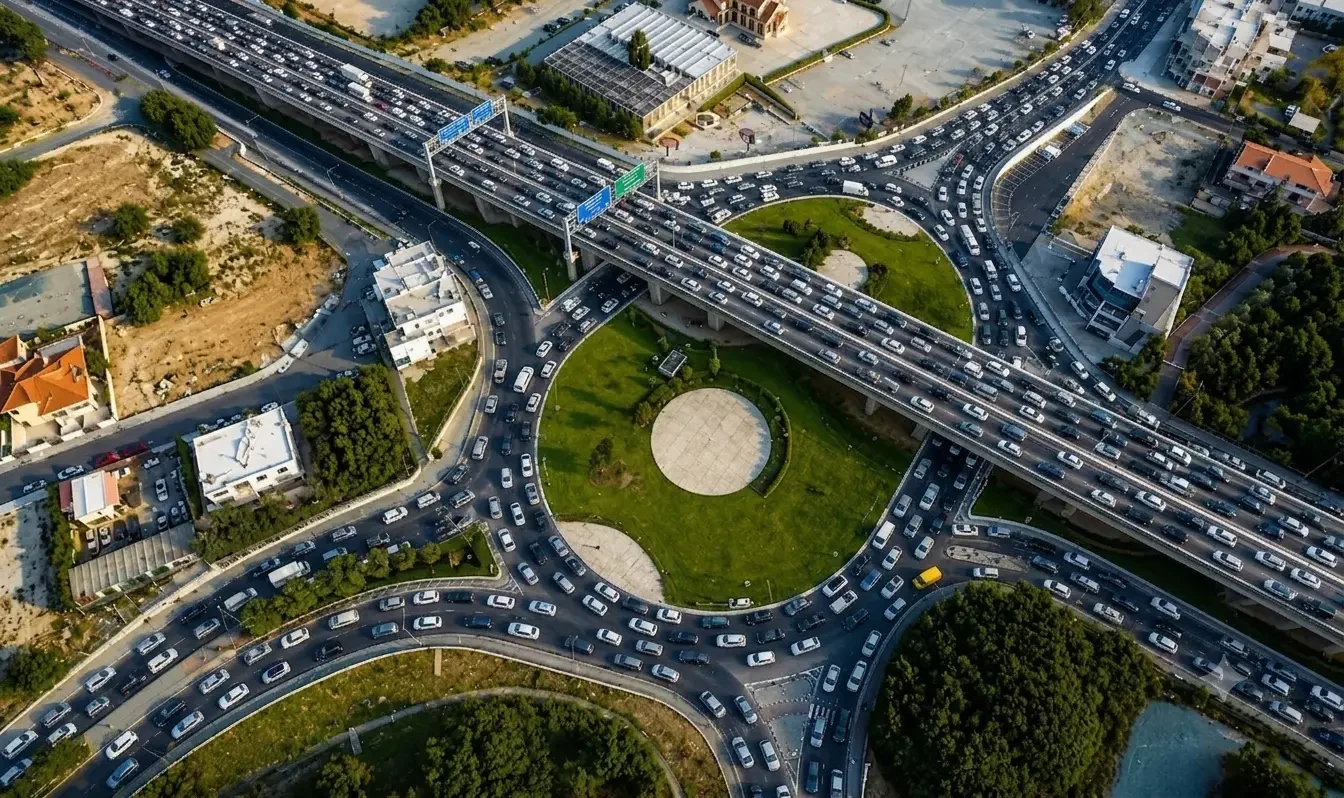
Cyprus drivers lost an average of 40.2 hours in peak-hour traffic during 2023, against an EU average of 28.6. That is roughly 40% worse than the European norm, and it is a full working week spent stationary.
This is the statistic with the most direct bearing on a purchase decision, and it points in a specific direction.
It argues for hybrids over diesels. A conventional engine idling in a queue burns fuel and produces nothing. A hybrid runs on the electric motor at crawling speed, which is precisely where its efficiency advantage is largest. Toyota and Lexus hybrids were engineered around exactly this cycle, and the registration data showing Cypriot buyers moving toward hybrids faster than toward full EVs suggests the market has already worked this out.
It changes which options matter. Adaptive cruise control with stop-and-go, seat quality, cabin insulation and climate performance are worth more over forty hours of standstill than an extra fifty horsepower will ever be. Buyers importing to specification should weight the list accordingly.
It makes plug-in hybrids unusually well suited to the island. Short distances, heavy congestion and home charging are the conditions in which a PHEV spends most of its life on electricity.
Charging capacity is 25 times the EU requirement
Under the EU's Alternative Fuels Infrastructure Regulation, Cyprus was required to provide 608 kW of charging capacity. It has installed 15,472 kW — over twenty-five times the minimum.
That undercuts the most common objection to buying an electric car here. It does not, on its own, tell you whether chargers are where you need them or how fast the individual units are `[VERIFY — check current distribution and maximum output per site]`, and for most owners home charging will still do the daily work. But the claim that Cyprus lacks charging capacity is no longer supported by the data.
Transport is 37.9% of the island's emissions
In 2023 transport — including international aviation and maritime fuel — accounted for 37.9% of Cyprus's total greenhouse gas emissions, or 3.9 million tonnes of CO₂ equivalent. The EU average is 31%.
This is the reason road tax here is calculated on CO₂ rather than engine size, and the reason grant schemes for electric and hybrid vehicles keep being renewed. It is also why the emissions figure on a specification sheet has a direct annual cost attached to it. Worth running any shortlist through the road tax calculator before comparing purchase prices.
Among the safest roads in the EU
Despite that dependence on cars, Cyprus ranked eighth of 27 member states for the lowest road fatalities per million inhabitants in 2023, at 36 deaths per million. Measured against distance travelled it placed 14th, with 46 fatalities per 10 billion passenger kilometres.
For a country where almost all movement happens by road, that is a genuinely good result — and a useful corrective to the assumption that Cypriot roads are unusually dangerous.
Air and sea
Larnaca handled 8.876 million passengers in 2024, remaining the main hub. Across all airports Cyprus received 12.514 million passengers, about 0.8% of total EU traffic. Air freight through Larnaca reached 30,600 tonnes — effectively the country's entire air cargo volume.
Limassol was the busiest passenger port with roughly 9,000 passengers. For cargo, Zygi handled 4.212 million tonnes, 47% of the island's total maritime freight of 8.945 million tonnes.
For anyone importing a vehicle, that last set of figures is the physical reality behind the process: cars arrive by sea, and the ports handling them are working ports rather than passenger terminals.
What it adds up to
Cyprus is a country where you will drive everywhere, sit in more traffic than almost anywhere else in Europe, pay tax based on what your car emits, and have more charging capacity available than the EU asks for.
That combination favours a specific kind of car: efficient at low speed, comfortable when stationary, low on CO₂, and specified for the commute rather than the open road.
See what currently fits that description in our catalogue of cars in Cyprus.