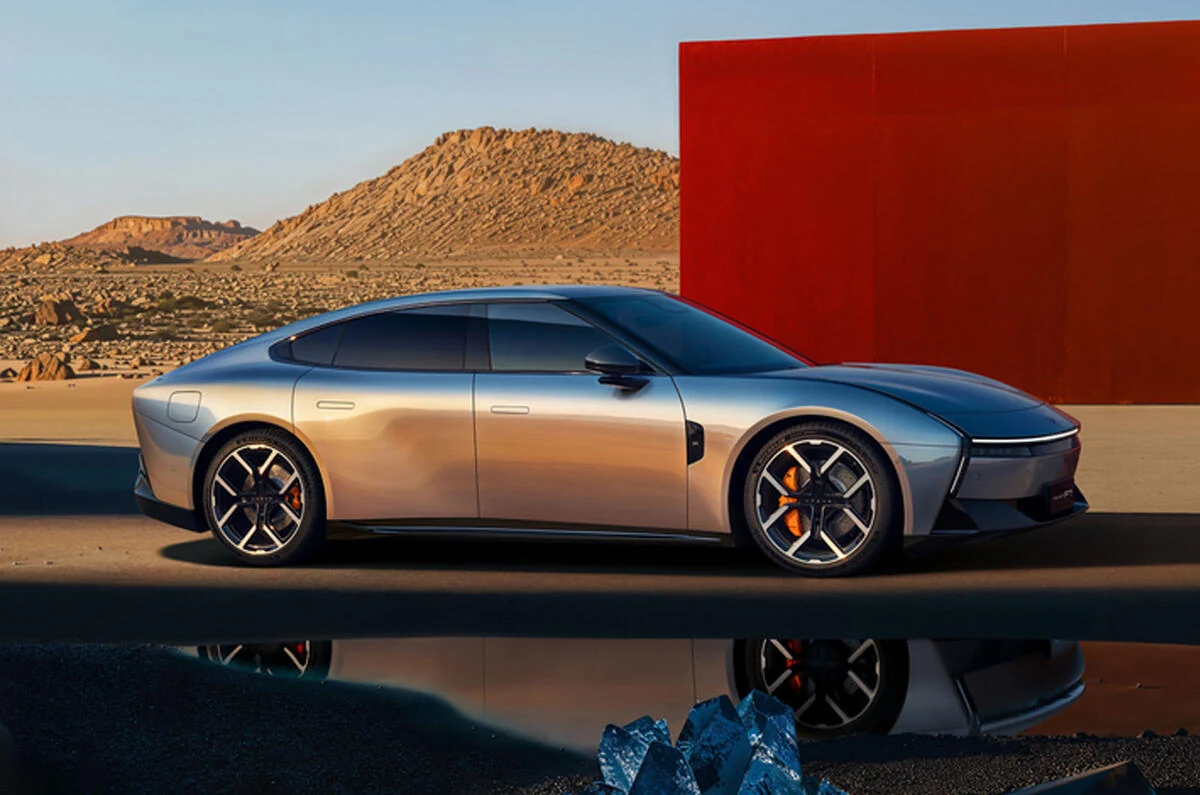
XPeng is not yet ten years old, but the Chinese manufacturer has a strategic partnership with Volkswagen and a clear intention to sell cars in Europe. The P7 electric saloon is the model it is leading with.
Shown in May and again at the Munich Motor Show, the P7 is planned for European launch in 2026.
The numbers
A dual-motor layout is understood to produce around 584 hp and 695 Nm, drawing on an 83 kWh battery. Zero to 100 km/h takes approximately 3.7 seconds, with a top speed of 229 km/h.
Range and charging figures have not been fully published. XPeng does claim a world record for distance covered in 24 hours by a mass-production electric car: 3,950 km.
The car uses XPeng's 800-volt architecture, which shortens charging times and reduces energy loss.
Designer Rafik Ferrag describes the result as a sports saloon rather than a family one — a full-width front lightbar, a sharpened silhouette and a roofline that runs into the rear deck in a coupé profile.
Inside, XPeng has released little beyond describing an "athletic five-seat coupé" with an AI-led cockpit. The company is targeting Level 4 autonomy — full autonomous operation within defined zones.
Why the Volkswagen partnership matters
A ten-year-old manufacturer entering Europe faces two problems that have little to do with the car: distribution and credibility. The Volkswagen partnership addresses both, and it is the reason XPeng is being taken more seriously than most new entrants from China.
A new research centre in Munich is intended to bring European preferences into development rather than adapting Chinese-market cars afterwards — the difference between a car designed for European roads and one translated for them.
That said, a partnership is not a dealer network. What decides whether you can own one of these is still whether an importer exists in your country and whether the car is built in the configuration your country requires.
What this means for a buyer in Cyprus
Start with availability, because it is not settled. XPeng's UK range currently consists of the G6 SUV, with the X9 MPV confirmed. The P7 has not been confirmed for Britain. That matters here more than in most markets: Cyprus drives on the left, so a car needs right-hand-drive production before anything else on the specification sheet applies.
If you are searching for this car because you want one on the island, that is the honest position — it is not confirmed, and a European launch does not automatically include Cyprus.
Level 4 autonomy will not operate here. Systems at this level are approved and mapped territory by territory. Cyprus is not among the jurisdictions where such approvals exist. Treat the capability as unavailable rather than pending.
584 hp is a road tax question, not a performance one. Cyprus calculates road tax on CO₂, so a fully electric car sits in the lowest band regardless of output. That is the practical argument for a car like this here — worth checking against a petrol equivalent of similar performance, where the annual difference is substantial.
Resale is the risk nobody prices in. On an island this size, a car is only worth what the next local buyer will pay, and that depends on whether local mechanics know the model and whether parts arrive in days rather than months. A first-generation entrant with no service history in Cyprus carries a discount at resale that does not appear anywhere in the purchase calculation. Factor it in at the start rather than discovering it at the end.
Established alternatives are available now. Tesla Model Y starts around €41,000 and the Polestar 4 around €55,000, both with service coverage in place. Neither matches the P7's headline figures, and both can be bought, registered and serviced here today.
For electric models available on the island today, see our catalogue of cars in Cyprus.