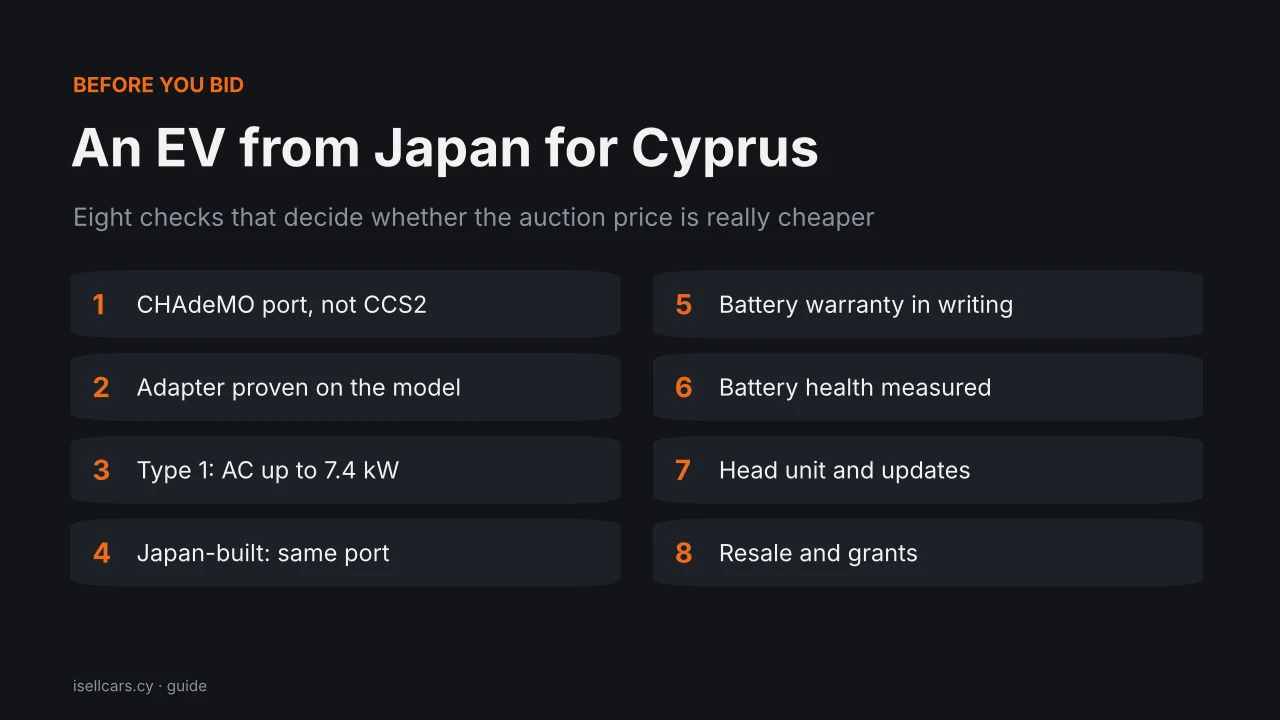
Don't buy an EV from Japan until you have read this. Japanese auctions are full of well-kept electric vehicles with low mileage. The hammer prices look like a bargain next to anything for sale in Cyprus. Some of them are. Many are not, because a Japanese-market EV was built for a charging network, a software region and a warranty system that Cyprus does not share. Most of what goes wrong is invisible on the auction sheet and only shows up once the vehicle is here.
These are the eight checks we run before bidding on any electric vehicle in Japan. If one of them fails, the cheaper price usually stops being cheaper.
The eight checks
1. Which fast-charging port does it have?
Japan fast-charges on CHAdeMO. Cyprus, like the rest of Europe, uses CCS2. Every new fast charger on the island is CCS2. This is not only a Japanese-brand issue: European manufacturers fitted CHAdeMO to the vehicles they sold in Japan. The Japanese-market BMW i4, Porsche Taycan and Audi e-tron all came with it. A Japanese-market EV therefore cannot plug into a Cyprus fast charger on its own.
2. Is there an adapter proven on this exact model?
CCS2-to-CHAdeMO adapters exist and sell in Europe for roughly €700 to €1,000. The cheaper units are limited to 50 kW. The better ones claim more, but the best real-world figure sellers report is around 75 kW. That figure comes from a small mass-market hatchback. A Taycan that takes well over 200 kW on its European port will charge at a fraction of that. Most adapters have been developed and tested on a handful of popular models, so a compatibility list on a seller’s page is a claim, not proof. Not every charger accepts them either. Ask for evidence from an owner of the same model before you count on one.
3. Can you live with slow AC charging?
For home and public AC charging, a Japanese-market EV has a Type 1 socket instead of Europe’s Type 2. An inexpensive Type 2 to Type 1 cable solves the plug. It does not solve the speed: Type 1 is single-phase, so the vehicle charges at no more than about 7.4 kW even on a three-phase 11 kW wallbox. If most of your charging happens overnight at home, that is workable. If you rely on public chargers, it is a daily compromise.
4. Japan-built does not fix the port
A Lexus built in Japan and shipped from Japan pays no import duty to Cyprus, which makes a Japanese-market Lexus EV look like the obvious exception. It is not. The Japanese-market Lexus RZ fast-charges on CHAdeMO like everything else sold there. The duty saving is real; the port problem comes with it.
5. Get the battery warranty confirmed in writing
On an EV the battery warranty is the one that matters. It is not international for every brand. Porsche is the clearest case: its Cyprus importer does not honour the factory warranty on a vehicle first sold in Japan; on a Taycan or Macan EV that is the warranty covering the battery. Other brands set their own rules. Before committing, ask for written confirmation from the brand’s official dealer or representative in Cyprus that the battery warranty will be recognised here.
6. Measure the battery, do not read it off the sheet
A Japanese auction sheet grades the body and interior and records the mileage. It is not a full battery report. State of health has to come from a diagnostic reading, arranged before export or on arrival, not from the range shown on the dashboard. Some degradation is normal; an outlier is the warning sign. Sustained heat is hard on batteries and Cyprus summers are long, so a weak battery will not get better here.
7. Software: the head unit and the updates
Navigation, menus, voice control and the radio band are all set for Japan. On some models a European conversion is a software job. On others the whole head unit has to be replaced, which is heavy work: on a Mercedes it can cost around €2,700 including VAT. After a conversion the vehicle has a Japanese VIN and a European head unit. Official over-the-air updates stop and installing one anyway risks bricking the vehicle. On an EV those updates carry battery management and charging improvements as well as infotainment, so the vehicle stays on the software it arrived with for the rest of its life.
8. Think about resale and grants now
The next buyer inherits every point above: the adapter, the slow AC charging, the uncertain battery warranty and the frozen software. Fewer people will take that on, so a Japanese-market EV takes longer to sell in Cyprus. Grants are no help either. The last scheme for used electric vehicles required an EC certificate of conformity, which a Japanese-market vehicle does not have. No grant is open in 2026. Our guide to the Cyprus EV grant covers what the scheme paid and what is expected in 2027.
What it adds to the auction price
Before comparing a Japanese EV with one from the UK or a Cyprus listing, add what the auction price leaves out. A European brand pays 10% import duty from Japan, the same as from the UK. On top of shipping, VAT and registration come the adapter at €700–1,000, the Type 2 to Type 1 cable, a battery health reading and, on some models, a new head unit at up to around €2,700. Shipping takes longer from Japan. The slower resale does not appear on any invoice, but you pay it when you sell.
When a Japanese EV still makes sense
It can work if you charge at home, rarely need a fast charger, have a written battery warranty answer from the brand in Cyprus and the price gap still covers everything above. That is a narrow case. For most buyers an EV from the UK is the simpler answer: CCS2 and Type 2 as standard, European software that keeps updating and every charger on the island available from day one. Electric vehicles pay no road tax in Cyprus whichever route they take.
For a vehicle listed in the UK, our UK import calculator shows the landed cost with duty, VAT and registration already in the figure. Tesla, which has no dealer in Cyprus, is a case of its own, covered in our comparison of Japanese and European Tesla.