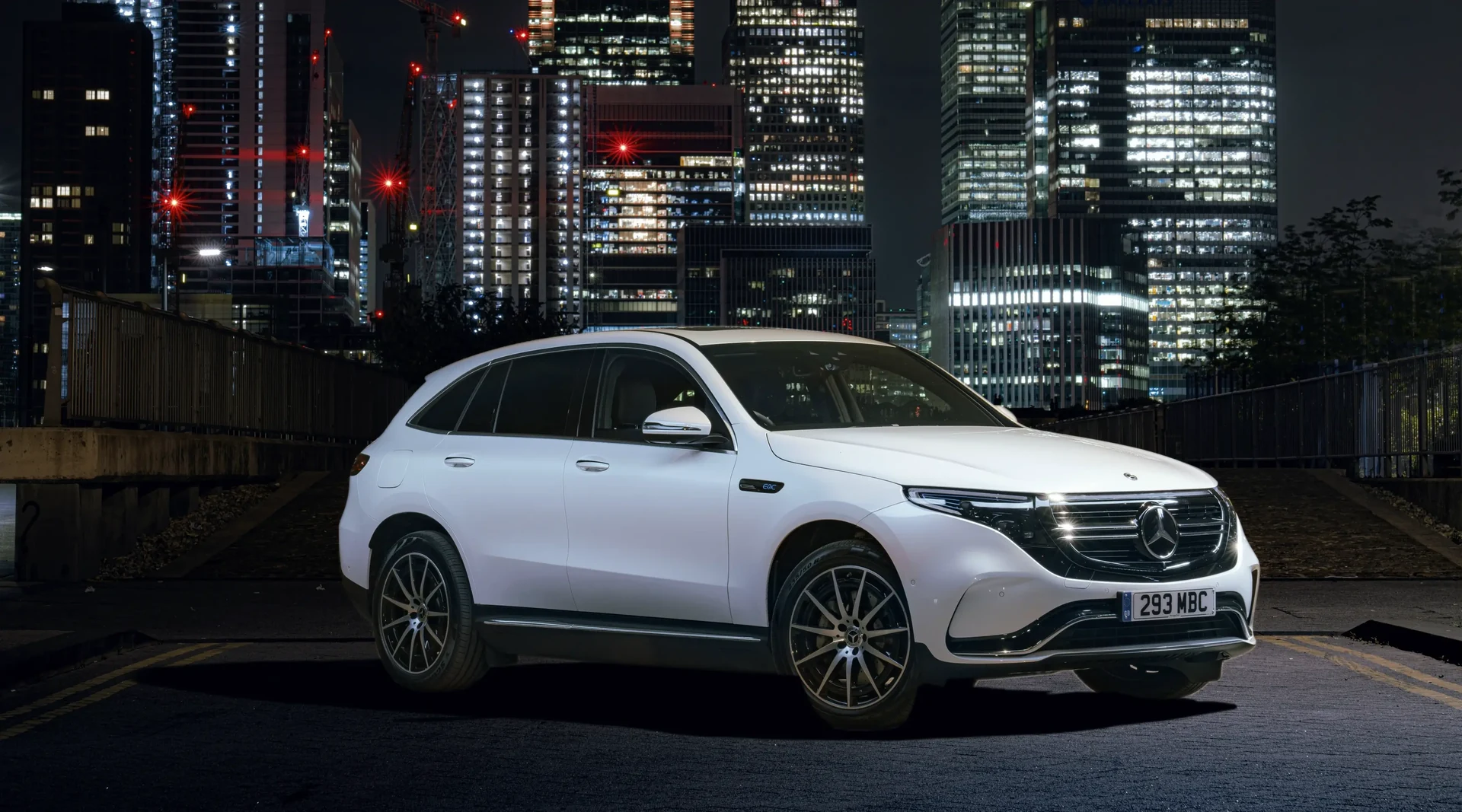
Mercedes has discontinued the EQC. Shown as the Concept EQ in 2016 and launched in 2019, it was the brand's first mainstream electric SUV — and it never quite escaped the circumstances of its own creation.
Why it fell behind
The EQC was brought to market without a dedicated electric platform. It was built on the combustion-engined GLC, and every consequence followed from that: constrained range, compromised efficiency, less interior space than its exterior dimensions suggested, and a kerb weight around two and a half tonnes.
As purpose-built rivals arrived — the Audi e-tron, Jaguar I-Pace, Tesla Model X, BMW iX3 and iX, Porsche Macan Electric, Audi Q6 e-tron, Polestar 4 — the gap widened rather than closed.
A successor has been seen testing. In the meantime Mercedes points buyers toward the EQE SUV, which uses a dedicated EV architecture. The next electric SUV is expected to drop the EQ badging, though the name has not been confirmed.
What this means for a buyer in Cyprus
A discontinued model is not automatically a bad purchase — but it changes the calculation. Production ending usually softens used values, which is precisely the moment a car becomes interesting to an importer. The EQC's weaknesses were relative to newer rivals, not absolute: it is a well-built, comfortable, quiet Mercedes SUV that happens to be less efficient than what replaced it.
Range matters less here than the specification implies. The EQC's real-world range was its most criticised trait in markets where people drive 400 km at a stretch. Cyprus is 240 km end to end. Limassol to Nicosia is 85 km. For an island commute with home charging, the gap between the EQC and a newer EV narrows considerably in practice.
Battery warranty is the question to ask before anything else. On a discontinued EV, remaining battery warranty is the single largest variable in what the car is worth. Establish the transfer terms, the remaining period and the state-of-health reading before committing. This applies to any used electric vehicle, but it applies more sharply to a model no longer in production.
Parts and servicing are less of a concern than with a new marque. Mercedes has long-established service coverage in Cyprus, and the EQC shares much of its structure with the GLC. That is a meaningful advantage over a discontinued model from a manufacturer with no local presence.
Road tax sits in the lowest band. Fully electric, so the Cyprus CO₂-based calculation puts it at the bottom regardless of its 2.5-tonne kerb weight — worth quantifying against the diesel GLC it was based on.
We commission Mercedes-Benz to specification from the UK, Japan and Australia, including discontinued models where the value case is strong. See what is available now.