New Audi RS 5: 630 hp, plug-in hybrid, and a surprisingly low CO₂ figure
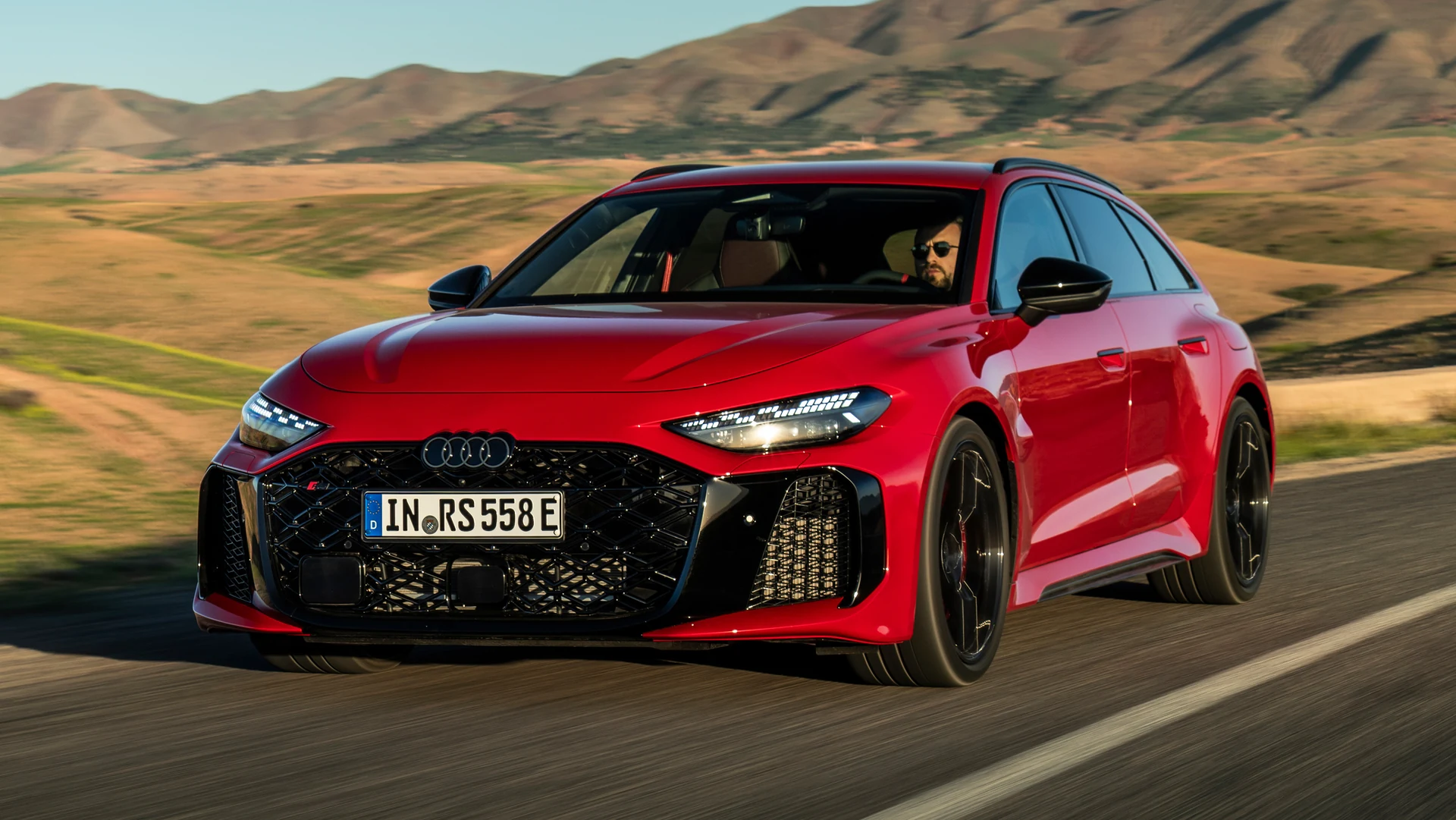
This is the all-new Audi RS 5 — the first of a new generation of RS models, developed to take on the top offerings from BMW M and Mercedes-AMG.
Like the BMW M5 before it, the RS 5 moves to a plug-in hybrid powertrain. It will be offered as a Saloon and an Avant, and goes on sale in Europe in the coming months. Prices start at around €105,000 for the saloon and €107,000 for the Avant — slightly under the BMW M3 Saloon and Touring.
What's driving it
At the centre of this new RS era is a high-performance plug-in hybrid system. It pairs a heavily revised 2.9-litre twin-turbo V6, carried over from the previous RS 4, with an electric motor and a 25.9 kWh battery.
The concept resembles the hybrid Porsche Panamera, but output is significantly higher and the package sits on Audi's more compact PPC platform.
Total system output is 630 hp and 825 Nm. The V6 alone produces 503 hp; the electric motor adds 174 hp and 460 Nm. The engine has been reworked substantially — new twin-scroll turbochargers, an updated fuel system and water-cooled intercoolers lift output from the previous 444 hp while still meeting Euro 7.
Drive goes through an eight-speed Tiptronic automatic with a conventional torque converter rather than a dual-clutch unit. A new centre differential varies torque split between 70:30 and 15:85 front to rear, and the rear axle gains its own differential with a compact electric motor, allowing torque vectoring and full locking.
Performance and efficiency
Audi claims 0–100 km/h in 3.6 seconds — half a second quicker than the previous RS 4 Avant. Top speed is 283 km/h with the Audi Sport package.
But the RS 5 is not only about pace. Electric range is around 84 km, average consumption is 3.8 to 4.5 l/100 km under current standards, and CO₂ emissions fall between 86 and 102 g/km.
Hold onto that last figure. It matters more in Cyprus than it does in Germany.
Chassis, brakes and the weight question
Body rigidity is up noticeably and overall width has grown by 90 mm. Almost every body panel is unique — only the bonnet, outer front door skins, roof and boot lid are shared with the standard A5.
The suspension uses springs and two-valve dampers that adjust compression and rebound independently, giving engineers more room to balance comfort against control. Audi has left out several expensive systems, though: no rear-axle steering, no hydraulically linked dampers, no air suspension.
That's notable given the mass — 2,355 kg for the saloon, 2,370 kg for the Avant.
To manage it, the RS 5 gets 420 mm front and 400 mm rear brakes as standard. Optional carbon-ceramics take those to 440 mm and 420 mm, putting it among the largest brake packages on any production car — level with the Lamborghini Urus and Bentley Continental GT Speed.
Design and interior
The three-dimensional grille carries a complex mesh pattern and a black mask linking it to the side intakes. Widened arches house 20-inch wheels as standard, though 21s will likely be the popular choice. At the rear sit a large diffuser and oversized oval tailpipes, pushed toward the centre by the exhaust routing.
Cars with the Audi Sport package add forged-carbon detailing, a different front bumper and forged 21-inch wheels. The saloon also gains a boot-lid spoiler.
Inside, Audi continues its screen-led architecture with new sports seats and carbon trim. The displays carry Audi Sport graphics, and a Boost button on the wheel unlocks maximum power and torque for ten seconds in any drive mode.
What this means for a buyer in Cyprus
The CO₂ figure is the headline here, not the horsepower. Cyprus road tax is calculated on emissions, and 86–102 g/km is territory normally occupied by small hatchbacks. A 630 hp estate landing in a low band is unusual, and it changes the ownership maths against a petrol-only rival with similar performance. Run the numbers on the road tax calculator before comparing it to anything else.
The 84 km electric range covers most of the island. Limassol to Nicosia is roughly 85 km, Limassol to Larnaca about 70, Limassol to Paphos about 65. For a driver whose week is commuting and intercity runs with charging at home, a large share of those journeys sit inside the battery. That is a materially different proposition from the same car in Germany, where 84 km is a commute.
Right-hand drive means the UK, not Germany. The European launch is a left-hand-drive launch. Cyprus needs right-hand drive, and Audi builds RS models in RHD for the UK and Ireland. In practice a Cyprus buyer is looking at a UK import, which affects specification availability, lead time and the duty and VAT structure of the landed cost.
Hybrid incentives may apply. Cyprus operates grant schemes for electric and plug-in hybrid vehicles, and eligibility depends on the scheme open at the time of registration and on the vehicle's specification. Our guide on claiming the Cyprus EV and hybrid subsidy on an import covers the process.
The competition
The RS 5's rivals remain the Mercedes-AMG C 63, the BMW M3 and the Alfa Romeo Giulia Quadrifoglio — though all three are mid-transition.
The next M3 is expected to take a mild-hybrid system while keeping its familiar concept, alongside a fully electric version. Alfa Romeo plans to keep building the current Giulia and Stelvio Quadrifoglio until Euro 7 forces them out.
Mercedes-AMG's recent experience is the clearest guide to how buyers might react. The last C 63's switch to a four-cylinder plug-in hybrid met a cool reception, and AMG replaced it with the mild-hybrid C 53 and its straight-six.
Audi's approach is different. The RS 5 keeps the V6 and uses electrification to sharpen the car rather than reinvent it — the same route BMW took with the M5 in retaining its V8, which has already proved commercially sound.